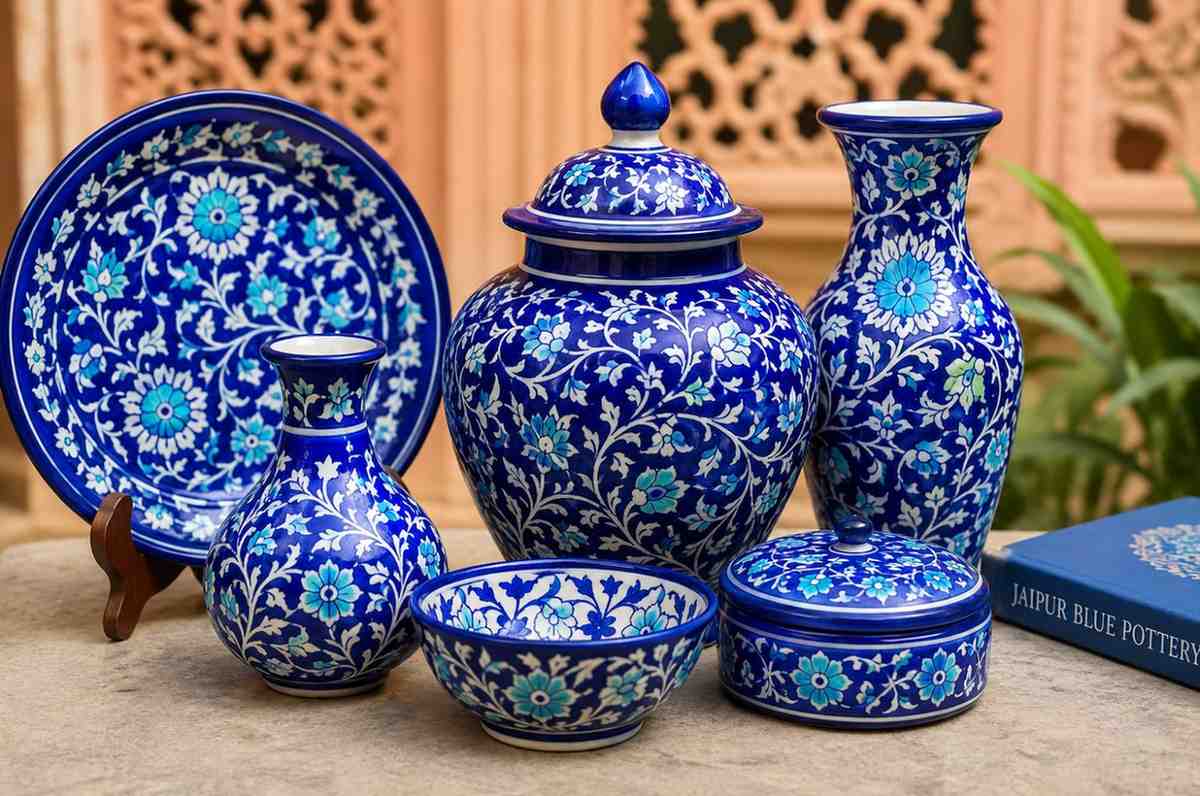
Blue Pottery If you’ve ever walked through the bazaars of Jaipur and spotted those vivid blue-and-white vases staring back at you, you already know the feeling. There’s something about blue pottery that stops people mid-step. It’s elegant, it’s ancient, and — here’s the fun part — it doesn’t even use clay.
Yes, you read that right.
What Exactly Is Blue Pottery?
Blue pottery is a traditional craft widely recognized as the signature art form of Jaipur, Rajasthan. The name comes from its most defining feature: a striking cobalt blue dye that gives each piece its iconic look.
What truly sets it apart from every other pottery style in the world is its composition. Most pottery relies on clay as its foundation. Blue pottery uses none.
Instead, artisans prepare a dough by mixing quartz stone powder, powdered glass, Multani Mitti (Fuller’s Earth), borax, gum, and water. The result is a material similar to Egyptian faience — glazed, low-fired, and distinctively smooth.
This isn’t just a quirky fact for trivia nights. It’s the reason blue pottery doesn’t crack, remains hygienic, and lasts for generations when handled with care.
Also Read:
Pichwai Paintings: The 400-Year-Old Art Form That Still Stops People in Their Tracks
A Journey That Crossed Continents
Blue pottery didn’t just appear one morning in Jaipur. Its story stretches across centuries and continents, involving empires, trade routes, and one very memorable kite-flying competition.
The craft traces its earliest roots to Central Asia and the Middle East. Cobalt blue pigment — mined from cobalt oxide — was first used in Iraq under the Abbasid Caliphate as early as the 9th century. From there,
it traveled east through trade routes, merging Persian decorative artistry with Chinese glazing techniques under Mongol craftsmanship.
According to Wikipedia’s documented history of Jaipur Blue Pottery, the technique entered India through Turkic conquests in the 14th century.
It first appeared in Delhi and Multan, before the Mughals adopted and elevated it, using blue glazed tiles to decorate mosques, tombs, and palaces across their empire.
The art form then made its way westward through Rajasthan — not through conquests, but through something far more entertaining.
The Kite-Flying Story That Changed Everything
King Sawai Ram Singh II of Jaipur (who ruled from 1835 to 1880) was watching a kite-flying event when he noticed two brothers from Achnera repeatedly cutting down the royal kites. Naturally, no king enjoys losing at kite battles.
He summoned the brothers — Churaman and Kaluram — to learn their secret. Their answer was simple: they were potters, and they had coated their kite strings with the same blue-green glass glaze they used on their pottery.
Ram Singh was so impressed that he invited the brothers to settle in Jaipur and teach their craft at his newly established School of Art. He also sent local artisans to Delhi to train under the famed potter Bhola.
That’s how a kite-flying tournament accidentally preserved one of India’s most celebrated art forms. History has a sense of humour.
How Blue Pottery Is Made
The making of blue pottery is not a quick weekend project. Each piece passes through over 42 hand processes and takes roughly 20 to 25 days to complete from start to finish, as documented by Ram Gopal Blue Pottery Studio.
Here’s a simplified look at the process:
1. Preparing the Dough Raw materials — quartz powder, scrap glass, Multani Mitti, borax, and gum — are combined with water and kneaded into a workable dough.
2. Shaping The dough is pressed into moulds or shaped by hand. A traditional wooden tool called thepai flattens the dough into smooth sheets before moulding begins.
3. Drying and Scrubbing Shaped pieces are dried slowly to avoid warping. Edges are scraped and smoothed to refine the form.
4. Hand Painting This is where the magic happens. Artisans hand-paint intricate designs using fine brushes — traditionally made from squirrel tail hair. Designs draw from Persian floral patterns, Mughal arabesque motifs, birds, animals, geometric shapes, and sometimes even Hindu deities like Goddess Durga and Lord Ganesh.
5. Glazing and Firing Once painted, pieces are coated with a glaze and fired in a kiln at temperatures reaching up to 850°C.
The kiln sits for 24 to 48 hours after firing before it’s opened, allowing pieces to cool gradually. Rushing this step can ruin everything — patience is quite literally baked in.
The colour palette is primarily blue (from cobalt oxide), green (from copper oxide), and white, though contemporary artisans have expanded into yellow, brown, and other non-traditional shades.
The Near Death and Dramatic Revival of Blue Pottery
By the 1950s, blue pottery had almost vanished from Jaipur entirely. The rise of mass-produced ceramics, dwindling royal patronage, and the sheer difficulty of the craft pushed most artisans away toward easier livelihoods.
That’s where Kripal Singh Shekhawat enters the story.
Shekhawat (1922–2008) was a muralist and painter who had studied at Shantiniketan and earned a diploma in Oriental Arts from Tokyo University.
He took charge of the ceramic department at Jaipur’s School of Art and threw himself into reviving the dying craft.
He didn’t just restore it — he expanded the traditional two-shade palette to as many as 24 shades, making blue pottery more vibrant and versatile than it had ever been before.
With support from Maharani Gayatri Devi and social reformer Kamaladevi Chattopadhyay, Shekhawat established the Sawai Ram Singh Shilpa Kala Mandir in 1963, which became a training hub and marketplace for blue pottery artisans.
For his extraordinary contribution, Shekhawat received the Padma Shri in 1974 and was honoured with the title Shilp Guru by the Government of India in 2002.
He is widely called the father of modern blue pottery. His studio, Kripal Kumbh, still operates in Jaipur today, run by his family.
The GI Tag: Official Recognition at Last
In recognition of its unique identity, blue pottery of Jaipur received the Geographical Indication (GI) tag from the Government of India.
This tag legally ties the craft to Jaipur, ensuring that only genuinely produced Jaipur blue pottery can carry that identity in the market.
The GI tag matters because it protects artisans from imitation products flooding the market — a real problem for handcrafted goods that require weeks of skill to produce.
What Blue Pottery Looks Like Today
Blue pottery is no longer limited to decorative vases collecting dust on a shelf. Today’s artisans produce a wide range of products: plates, bowls, tiles, coasters, soap dishes, door knobs, trinket boxes, photo frames, and even bathroom fittings and jewellery.
Entrepreneur Leela Bordia, who relocated to Jaipur in 1974, played a key role in pushing blue pottery into interior décor and global export markets. She extended the craft into beads, pendants, and necklaces introducing blue pottery to fashion audiences who might never have visited a Rajasthan bazaar.
The removal of lead from glazes a change from older production methods has also made blue pottery safe for daily use as dinnerware, opening an entirely new category of buyers.
Why Blue Pottery Deserves More Attention
Here’s the honest truth: blue pottery sits in a rare category of crafts that are simultaneously functional, beautiful, historically layered, and endangered.
The number of active units in and around Jaipur is small — estimates suggest only 25 to 30 active producers remain, with most concentrated in Jaipur city and the village of Kot Jebar.
The craft demands time, patience, and trained hands. In a world that expects things fast and cheap, those are difficult qualities to sustain commercially.
But each blue pottery piece carries something that no factory can replicate: the mark of a human hand, the echo of centuries of cultural exchange between Persia, Central Asia, China, and India, and the legacy of a kite-flying king who had the good sense to recognise brilliance when it cut his string.
Final Thoughts
Blue pottery is more than a pretty souvenir from Rajasthan’s Pink City. It’s a living record of how art moves — across empires, trade routes, and royal courts — and how it sometimes survives almost purely by accident and sheer human dedication.
Next time you hold a blue pottery piece, you’re holding a small part of that entire journey.
That’s not a bad thing for something made without any clay.