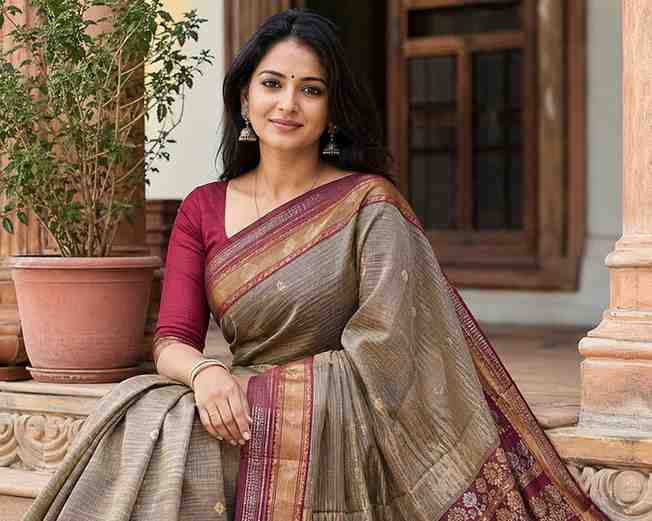
There’s a town in Madhya Pradesh where the Narmada River flows quietly past an ancient fort, and inside that fort, looms still hum the same rhythm they did three centuries ago.
That town is Maheshwar. And the fabric that comes off those looms? That’s a Maheshwari saree — one of India’s most treasured handloom traditions, worn by queens, gifted to dignitaries, and somehow still very much alive today.
Let’s talk about why.
Where It All Began: Maheshwar and Ahilyabai Holkar
Maheshwari sarees trace their origin to the 18th century, born in the town of Maheshwar on the banks of the Narmada River in Madhya Pradesh. The weaving tradition in this region actually goes much further back — Madhya Pradesh Tourism documents that Maheshwar has been a handloom hub since the 5th century, with a possible mention in Kautilya’s Arthashastra.
But the saree as we know it today — that’s Ahilyabai Holkar’s doing.
Maharani Ahilyabai Holkar, who ruled from 1765 to 1795, was a visionary administrator and a passionate patron of arts. She wanted to create a gift that truly reflected the heritage of Maheshwar for the royal guests who frequently visited her capital.
Her solution? She brought in master weavers from Surat and Mandu and asked them to design a special saree inspired by the intricate carvings on the Maheshwar Fort and its temples. According to local tradition, Ahilyabai herself designed the first patterns.
Those original sarees were called Garbh Reshmi — meaning “silk from the womb” — and were woven in pure silk for the royal household. The name tells you everything about the quality she demanded.
What Makes a Maheshwari Saree Actually Different
Here’s where things get genuinely interesting.
Maheshwari sarees don’t follow the same logic as most other Indian sarees. They’re not about heavy embellishments or loud designs. Their whole identity is built around architectural geometry and a very specific fabric combination.
The fabric: Maheshwari sarees use a silk warp and a fine cotton weft. Silk from Bangalore, cotton yarn from Coimbatore — this blend creates a fabric that is simultaneously light, soft, and slightly lustrous. According to Wikipedia’s documentation on Maheshwari sarees, the cotton used is often an 80s count or 2/120s count, which is very fine even by Indian handloom standards.
The motifs: Unlike the complex florals of a Banarasi or a Paithani, Maheshwari designs draw directly from architecture. Common patterns include:
- Chatai (mat weave pattern)
- Eent (brick pattern, inspired by the fort walls)
- Leher (wave pattern, echoing the Narmada)
- Diya (lamp motif)
- Tara (star design)
These aren’t decorative choices — they’re a literal visual record of the town the saree comes from.
The reversible border: One hallmark of a traditional Maheshwari saree is the bugdi — a reversible border that allows the saree to be worn on either side. That’s not just elegance; that’s smart design.
The pallu: The traditional Maheshwari pallu features five distinct stripes — three coloured and two white, alternating. This “panchphool” pattern is instantly recognisable and sets an authentic piece apart from imitations.
The Five Types You Should Know
Maheshwari sarees don’t come in one uniform style. There are five major categories, each with its own character.
Chandrakala and Baingani Chandrakala are the plain versions — solid body, elegant border, understated appeal. Chandratara, Beli, and Parbi fall under the striped or checked category, with more visual movement and texture.
Originally, the traditional colour palette ran deep — reds, maroons, blacks, greens, and purples. Over time, lighter colours entered the range, along with gold and silver zari threads for borders, giving the saree a contemporary appeal without losing its classical bones.
The Near Collapse No One Talks About
Here’s the part that most saree enthusiasts don’t know: Maheshwari weaving nearly vanished in the 20th century, and not because people stopped appreciating it.
Industrialisation hit Maheshwar hard. As cheap, power-loom fabrics flooded the market in the early 1900s, demand for handwoven Maheshwari sarees collapsed. Weavers, left with no income and no market, either dismantled their looms or left Maheshwar entirely. A craft that had survived Mughal invasions and British colonial rule couldn’t survive affordable synthetic alternatives.
By the mid-20th century, the tradition was on life support.
The Revival: A Royal Couple and Eight Women
The turnaround came from an unlikely direction.
Richard Holkar, son of Maharaja Yeshwant Rao Holkar II, and his wife Sally Holkar — an American-born Stanford graduate who had married into the Holkar dynasty — arrived in Maheshwar and found the situation grim. A weaver had come to their gate trying to sell his wares. In the conversation that followed, Sally understood there was still skill, still tradition — but no marketing, no market, and no future without both.
In 1978, they founded the Rehwa Society, a not-for-profit organisation housed within Ahilya Fort itself. They started with a grant from the Indian Central Welfare Board, eight looms, and eight women weavers from the local Meru community, led by master craftsman Shri Ganesh Bichwe, whose family had woven Maheshwari since the original artisans of Ahilyabai’s time.
That’s a remarkable origin for something that has since grown into 250 weavers, 1,500 looms, and an internationally recognised handloom brand — as documented by both Wikipedia’s Rehwa Society article and Madhya Pradesh Tourism.
Sally Holkar’s contribution didn’t stop at loom revival. Rehwa also built schools for weavers’ children, created stable employment primarily for women, and showed that traditional craft and sustainable business could coexist. In 2025, she received the Padma Shri — India’s fourth-highest civilian honour — for her decades of work in social service and handloom preservation.
GI Tag: Protected by Law Since 2010
In 2010, Maheshwari sarees received the Geographical Indication (GI) tag from the Government of India.
This is more significant than it sounds. The GI tag legally establishes that only sarees woven in Maheshwar can carry this name. It protects artisans from cheap imitations — and there are many in the market. Several vendors sell machine-made SICO (silk-cotton) material with block prints as “Maheshwari,” which is, to put it plainly, misleading.
An authentic Maheshwari saree is entirely handwoven. It comes off a traditional pit loom or frame loom, passes through over 42 hand processes, and takes considerable time to produce. The GI tag exists precisely to protect the value of that labour and skill.
How to Identify an Authentic Maheshwari Saree
Since imitations are common, here’s what to look for:
Texture: Authentic Maheshwari fabric feels lightweight, crisp, and slightly cool to the touch. The silk-cotton blend gives it a softness that synthetic fabrics can’t replicate.
Border: Look for the reversible bugdi border. Geometric patterns — not complex florals — dominate the weave.
Pallu: The traditional five-stripe (panchphool) pallu is a reliable sign of authenticity.
Label and source: A genuine piece often carries a GI-certified label. Buying directly from the Rehwa Society, government-run Mrignayanee emporiums, or verified handloom co-operatives removes most of the risk.
If a seller can’t tell you which loom or co-operative the saree came from, that’s worth questioning.
Maheshwari Sarees Today: From Fort to Fashion Week
Today, Maheshwari sarees appear on fashion runways, in designer collections, and on social media — often draped by people who may not know the full story behind what they’re wearing.
That’s both a good sign and a reason to stay cautious. The popularity creates demand, which supports weavers. But it also attracts imitation products that drain revenue from the artisans who actually do the work.
The fabric itself has expanded beyond sarees. Maheshwari fabric now appears in salwar suits, dupattas, stoles, scarves, and even home furnishings. Designers have introduced fusion styles and new colourways without abandoning the core geometric identity that makes Maheshwari weaving distinct.
For buyers, this is a genuinely versatile textile. Light enough for summer, textured enough for formal events, and understated enough to carry well in any setting.
Also Read:
Banarasi Saree: India’s Most Iconic Weave With a Story That Spans Centuries
Why Buying Maheshwari Sarees Actually Matters
Every authentic Maheshwari saree you buy supports a weaver in Maheshwar — and in most cases, that weaver is a woman.
The Rehwa Society built its entire model around women’s employment. Today, most of its 250 weavers are women who earn through a craft that their community had practiced for generations but lost access to as livelihoods disappeared.
Choosing authentic Maheshwari over machine-made alternatives is one of those rare purchasing decisions that is simultaneously practical, stylish, and genuinely meaningful.
A saree woven on a pit loom in a fort town on the Narmada River inspired by stone carvings, refined by a queen, nearly lost to industrialisation, and brought back by a Stanford graduate with a commitment to craft carries more story per thread than most things in your wardrobe ever will.