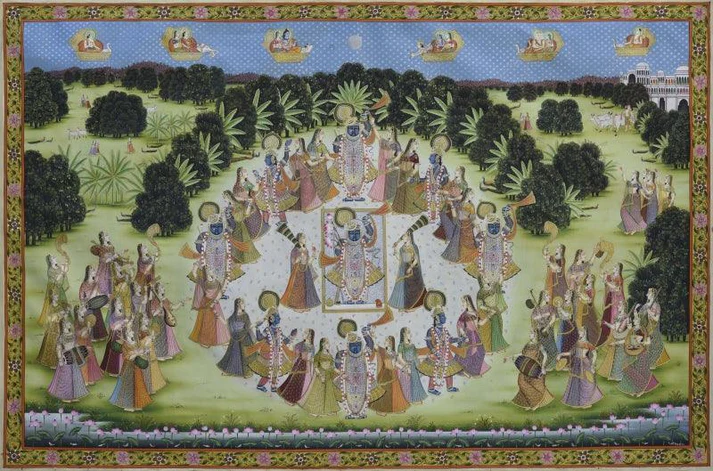
Pichwai paintings These aren’t just pretty pictures hanging on a wall. Every single Pichwai is a devotional story, a seasonal diary, and a masterpiece of human patience — all rolled into one large piece of painted cloth.
And the best part? Most people walking past one in a gallery have no idea what they’re actually looking at.
What Are Pichwai Paintings?
The word Pichwai comes from two Sanskrit words — pichh meaning “back” and wai meaning “hanging.” Put them together and you get “that which hangs at the back.” Simple enough, right?
But the art form itself is anything but simple.
Pichwai paintings are large devotional Hindu painted pictures, normally on cloth, which portray Krishna. They are mainly made to hang in Hindu temples of the Pushtimarg devotional tradition, especially the Shrinathji Temple in Nathdwara, Rajasthan, built around 1672.
So yes — these paintings were literally designed to serve as divine backdrops inside temples. Not decoration. Divine storytelling.
Where Did Pichwai Art Come From?
The roots of Pichwai paintings trace back over 400 years to the 17th century. They emerged as a part of the Pushtimarg sect founded by Shri Vallabhacharya, which emphasizes devotion (bhakti) through music, arts, and temple rituals.
Here’s a fascinating piece of history that most people miss. Around the year 1669, the Mughal emperor Aurangzeb had ordered the demolition of all Hindu temples in India.
It was during this time that many devotees of Shrinathji at Mount Govardhan set out with the idol of Shrinathji.
The idol eventually found a permanent home in Nathdwara, Rajasthan — and the town became the heartland of Pichwai art from that point forward.
Nathdwara, which means “Gateway of the Lord,” became a major Pichwai painting center due to its association with Shrinathji.
The Shrinathji Temple is one of the main pilgrimage sites of Pushtimarg followers.
That’s not just art history. That’s survival, devotion, and creativity all colliding at once.
The Spiritual Purpose Behind Every Painting
Here’s something that sets Pichwai apart from almost every other Indian art form — the paintings change with the seasons and festivals. They aren’t static décor. They’re living visual calendars.
Each festival and ritual within the faith is an elaborate affair, with a Pichwai showcasing the adornment, emotions, mood, music, food, and dancing that encompass the worship.
With daily worship of Shrinathji having 8 different formal viewings, Pichwais may often depict the eight different adornments associated with each viewing.
So on Janmashtami, the temple gets one Pichwai. On Sharad Purnima, a completely different one goes up. On Holi, yet another.
Think of it as the world’s most elaborate and spiritually charged festival playlist — except it’s painted by hand, takes months to make, and is hung behind a deity.
Festivals such as Govardhan Puja, Sharad Purnima, Raas Leela, and Holi, alongside other prominent festivals in Pushtimarg, are depicted with vivid detail on the modes of worship and the items used.
These Pichwais often also serve as historical documentation of how and who participated in these festivals throughout the tradition’s history.
What Does a Pichwai Actually Look Like?
Now we get to the good stuff. Pichwai paintings are visually dense in the best possible way. There is always something new to find in them.
The central figure is almost always Shrinathji — depicted with distinct features of a heavier body and large elongated eyes, with a broad nose of Shrinathji, similar to the features of the idol at the temple.
Surrounding the deity, you’ll typically find:
- Lotus ponds — evoking purity and Shrinathji’s water excursions
- Sacred cows — sometimes shown as the divine Kamdhenu, symbolizing nourishment
- Peacocks — tied to monsoon, beauty, and Krishna’s iconic feathered crown
- Gopis and Radha — shown dancing, devoted, and luminous
- The Yamuna river, forests, and celestial beings watching from above
Pichwai paintings have different themes which keep changing according to the seasons. The painting depicting pink lotuses in summer contrasts with the one for Sharad Purnima, which features a bright full moon in a night scene.
Every single motif has a meaning. Nothing is randomly placed. That’s not artistic pretension — that’s 400 years of intentional visual theology.
How Are Pichwai Paintings Made?
This is where things get genuinely jaw-dropping.
Originally, Pichwai was painted on handspun starched cotton fabric. The artisans would sketch the art on that starched cloth, then create decorative images painted with completely organic and natural colors obtained from coals, indigo, gold, silver, saffron, zinc, and other natural sources.
A 2019 NGMA workshop revealed that some master artisans still mix paints before dawn to preserve color luminosity. If that doesn’t tell you how seriously these artists take their craft, nothing will.
Pichwai artists use fine, precise brushes to create intricate details. The patterns and lines are intricate and require a lot of patience and skill. Some Pichwai artworks incorporate textures raised by a rice paste mixture, adding a three-dimensional element to the work.
And how long does all of this take? The making of a traditional Pichwai consumes a couple of weeks that can even stretch to months.
That’s months — for a single painting. And people still complain that art is overpriced.
The Different Styles of Pichwai Art
Not all Pichwai paintings look alike. Over centuries, regional influences shaped distinct visual styles within the tradition.
The Mewar style, which originated in the Mewar region of India, is characterized by its use of bold colors, intricate detailing, and a strong focus on Shrinathji.
The Mughal-influenced style features finer details, softer colors, and intricate geometric and floral patterns. A third style is known for its romantic, ethereal quality, often depicting long, elongated bodies, dreamy scenery, and an otherworldly, serene atmosphere.
The Pichwai style of painting initially originated from Indian Miniature paintings.
Since the Nathdwara school of painting, where Pichwai paintings stem from, is a sub-style of the Mewar school of painting, these paintings are essentially a variation of the umbrella-style of Indian Miniature paintings.
So when you look at a Pichwai, you’re also looking at the DNA of Rajput and Mughal miniature traditions — filtered through centuries of devotion.
Who Makes Pichwai Paintings?
Pichwai painting has always been a community effort and a family legacy.
The pichhwai artisans in Nathdwara come from three main sub-castes — the Adi Gaur, who claim to have migrated from Udaipur; the Jangirs, who migrated from Jaipur and Jodhpur; and the lesser known Mewaras.
The artists live mostly in Chitron ki Gali (Street of Paintings) and Chitrakaron ka Mohallah (Colony of Painters) and are a close community with constant interaction.
Often a Pichwai painting is a group effort, where several skilful painters work together under the supervision of a master artist.
Historically, Pichwai art was a family tradition in Nathdwara, with lineages like the Sharma and Soni clans dominating production.
Renowned names include B.G. Sharma, Rajaram Sharma, Kalyanmal Sahu, and contemporary artists like Raghunandan Sharma and Kuldeepak Soni, whose works are now collected internationally.
Also Read:
Kota Doria Saree: The Featherlight Wonder from Rajasthan
Pichwai in the Modern World
Here’s the twist nobody expected: Pichwai paintings are having a serious moment.
Pichhwai have become the main export of Nathdwara and are in much demand among foreign visitors. They’ve gone from temple walls to gallery walls in New York, London, and beyond.
As interest in Indian heritage design has grown, Pichwai has become an important livelihood for artisans and workshops in Nathdwara and neighbouring towns.
Devotees and tourists purchase smaller Pichwais and reproductions as portable shrines and souvenirs, while large, fine examples enter galleries, museums, and private collections worldwide.
Even the fashion world got involved. Designers have utilised the traditional colours, printing techniques, and pattern styles associated with Pichwai in clothing attires and showcased them on international platforms such as Lakmé Fashion Week.
Contemporary artists are also keeping the tradition alive by experimenting thoughtfully.
Modern artists experiment with new themes, materials, and techniques — exploring canvas and paper alongside traditional cloth, using acrylics for a wider palette, and creating fusion art that combines Pichwai themes with contemporary styles.
That’s not a betrayal of tradition. That’s what living art forms do.
How Much Do Pichwai Paintings Cost?
Since people always ask — here’s a realistic picture.
The cost of Pichwai paintings in India can vary widely depending on factors such as size, delicacy of design, the craftsman’s reputation, and the materials used.
On average, a small to medium-sized Pichwai painting may range from a few thousand to several tens of thousands of Indian Rupees.
Larger and more detailed pieces, especially those made by famous artists, can demand significantly higher prices — often reaching lakhs or even crores of Indian Rupees.
Pricing above ₹5 lakhs is not unusual for museum-quality pieces. As investment art goes, Pichwai has shown strong collector interest at major auction houses including Saffronart.
Why Pichwai Paintings Deserve Your Attention
Most art forms tell stories. Pichwai paintings are stories — seasonal, spiritual, and human ones.
Pichwai painting has profoundly shaped the visual identity of Krishna devotion in western India, influencing temple décor, festival staging, textile design, and even contemporary graphic culture.
The art also preserves oral and ritual histories of Pushtimarg — each composition encodes specific stories, songs, and modes of worship, making Pichwai a visual archive of sectarian memory.
That’s remarkable. You’re not buying art. You’re acquiring a piece of a living religious tradition that has survived Mughal invasions, colonial disruption, and the relentless march of synthetic materials — and still thrives today in the lanes of Nathdwara.
Next time you see a Pichwai painting — in a gallery, in a home, or even on a designer saree — look a little closer. Count the lotuses. Find the cows. Look for Shrinathji standing with that arm raised, holding up a mountain with one hand, calm as ever.
There’s a 400-year-old story in there. And it’s worth reading every bit of it.