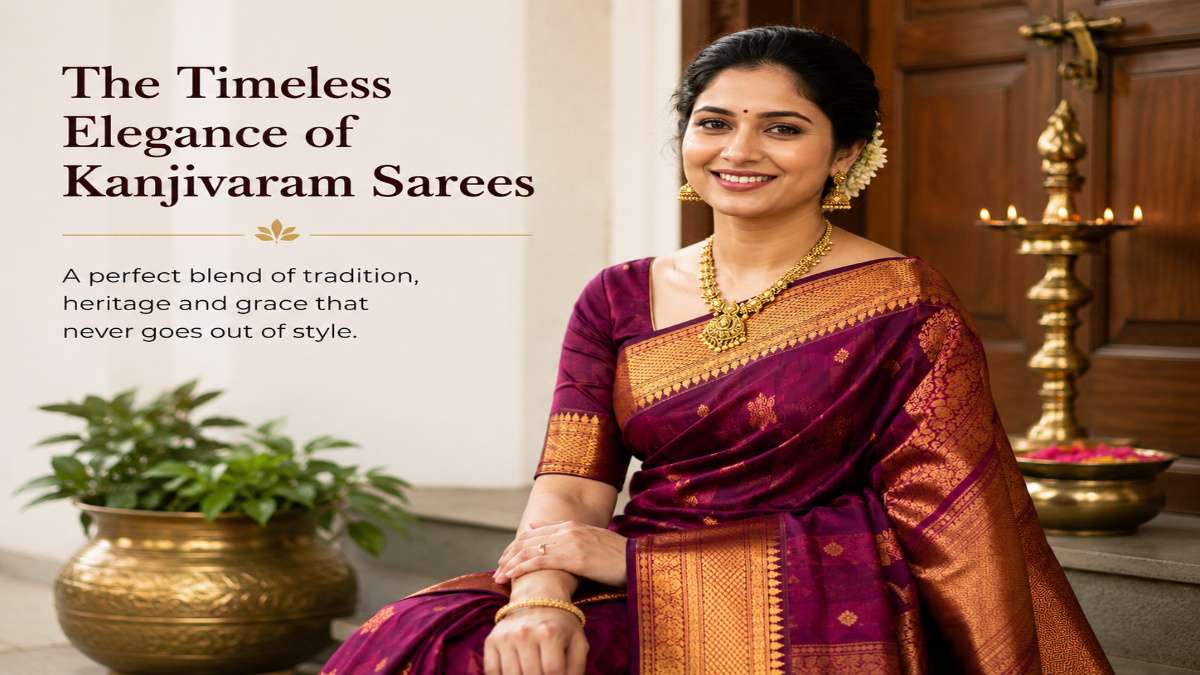
There are sarees. And then there is the Kanjivaram saree.
If you’ve ever stood near a bride draped in one, you already know the feeling — that quiet, unmistakable “wow.” It’s heavy, it’s rich, and it somehow manages to look regal without even trying. The Kanjivaram saree isn’t just fabric. It’s centuries of craft folded into six glorious yards.
Let’s talk about where it came from, what makes it special, and how to make sure you’re buying the real thing.
The Origin Story: Mythology Meets History
Every great thing has a great beginning. The Kanjivaram saree’s origin starts in — wait for it — divine mythology.
Legend holds that the weavers of Kanchipuram are descendants of Sage Markanda, the master weaver of the gods. According to this belief, Sage Markanda once wove a silk saree for Lord Vishnu from pure gold and lotus fibres. That’s the kind of origin story no fast-fashion brand can compete with.
In more historical terms, the roots of Kanjivaram silk sarees trace back to the 7th century CE, during the reign of the Pallava dynasty. The Pallava kings were enthusiastic patrons of art and craft, and silk weaving flourished in Kanchipuram under their royal support. Later, during the Vijayanagara Empire in the 15th century, skilled weavers migrated from Andhra Pradesh particularly from regions like Gudiwada and Saurashtra bringing their expertise with them and blending it with local traditions.
That fusion of techniques is exactly why Kanjivaram sarees have a style unlike anything else in the world.
Kanchipuram, the birthplace of this iconic saree, sits in Tamil Nadu. The town is home to 25 silk and cotton yarn industries and over 60 dyeing units a living, breathing ecosystem built entirely around this craft.
Banarasi Saree: India’s Most Iconic Weave
What Makes a Kanjivaram Saree Different?
Good question. Lots of sarees are silk. So why does the Kanjivaram get its own category?
The Silk Is Exceptional
Kanjivaram sarees use pure mulberry silk, primarily sourced from Karnataka. The silk threads are double-twisted to create a fabric that is unusually strong, lustrous, and heavy. Before weaving even begins, the raw silk yarns are boiled with rice starch to remove sericin (a natural protein that makes silk stiff), then sun-dried to boost strength and sheen.
This is not your average silk. This is silk that has been engineered over generations.
The Zari Is Real Gold (Almost Literally)
The zari – those shimmering metallic threads running through the borders and pallu, in an authentic Kanjivaram is made from fine silver wire wrapped around a silk thread, then electroplated with 22-karat gold. Under the Geographical Indication (GI) regulations, the zari in a certified Kanjivaram must contain at least 57% silver and 0.6% gold. That’s not decoration. That’s wearable Jewellery woven into cloth.
The Body and Border Are Woven Separately
This is the detail that separates real craftsmanship from imitation. In an authentic Kanjivaram saree, the body and the border are woven as two distinct pieces and then interlocked using a traditional technique called the Korvai method. The join is so precise that it creates an almost invisible seam — though you can spot a subtle zigzag pattern called the pitni where the two pieces meet.
This technique is why Kanjivaram sarees are extraordinarily durable. They don’t tear at the border, even after decades of use.
It Takes Weeks to Make One
A single Kanjivaram saree can take anywhere from 10 to 20 days to complete, depending on the complexity of the design. Three shuttles are used during weaving, and a loom with 240 holes in the warp and 60 holes in the weft handles the structure of this six-yard masterpiece. The result often weighs more than two kilograms. If someone offers you a “Kanjivaram” in two days, that should raise eyebrows.
The Motifs: A Temple on Your Shoulders
Kanjivaram saree designs aren’t random. Every motif carries meaning.
The inspirations come from South Indian temple architecture, Hindu mythology, and classical art forms. You’ll find peacocks, swans, lions, chariots, mangoes, coins, the sun, the moon, and lotus flowers woven into the fabric. Some sarees even depict scenes from the Mahabharata and the Ramayana.
Temple weave Kanjivarams feature gopurams (temple towers) along the borders, making them especially auspicious for weddings and religious occasions. Floral weave variants are lighter and more festive. Checks and stripes are popular for daily wear versions.
The designs have evolved over centuries from purely traditional to contemporary but the craftsmanship remains the same.
The GI Tag: Why It Matters
In 2005–06, the Government of India granted Kanchipuram sarees a Geographical Indication (GI) tag. This is significant. A GI tag is a legal certification under India’s Geographical Indications of Goods (Registration and Protection) Act, 1999, which means only sarees made in and around Kanchipuram by local weavers using traditional methods can legally be called Kanjivaram sarees.
GI TAG PRODUCT – KANCHEEVARAM SILKS AND SAREES
Before the GI tag existed, the market was flooded with counterfeit sarees sold as authentic Kanjivarams. Cheap power-loom versions from Surat would land in stores labelled as “Kanchipuram silk,” and buyers had no way to know the difference.
The GI tag changed that. It protects the weavers. It protects the buyers. And it protects the integrity of a craft that took centuries to develop.
How to Identify a Pure Kanjivaram Saree
This is where things get practical. The market still has plenty of imitations, so knowing what to look for is essential.
Check for the Silk Mark label. The Silk Mark Organisation of India issues certification labels that verify the fabric is 100% natural silk. This holographic label is the easiest and most reliable first check. A GI sticker alongside a Silk Mark label is the strongest dual verification you can have.
Feel the weight. Pure Kanjivaram sarees are noticeably heavier than synthetic or blended versions. The combination of mulberry silk and real zari gives the saree a substantial heft. If it feels light, be cautious.
Check the zari. Find a loose thread near the pallu and gently scratch beneath it. If you see a red silk thread underneath, it’s pure zari. If the inner thread is white or looks like plastic, it’s synthetic.
Look for the pitni. The slight zigzag pattern where the body and border join is a hallmark of the Korvai weaving technique. Machine-made sarees won’t have this.
Trust the touch. Pure silk feels cool, smooth, and firm — not slippery or plasticky. Scrunch a section in your palm and release it. Real silk springs back without creasing.
Respect the price. Authentic Kanjivaram sarees typically start around ₹10,000–₹15,000 and can go up to ₹2,00,000 or more for intricate bridal pieces. If someone is offering a “pure Kanjivaram” for ₹2,000, that’s not a deal. That’s a deception.
The Kanjivaram at Weddings: A Tradition That Won’t Retire
Ask any South Indian bride what she wants to wear, and the answer is almost always a Kanjivaram saree.
These sarees have been central to South Indian weddings for generations. Originally woven at nine yards in length, they were later standardised to six yards for practicality — though their grandeur hasn’t shrunk one bit.
South Indian families often pass Kanjivaram sarees down as heirlooms. A saree worn by a grandmother at her wedding can — with proper care — be worn by her granddaughter decades later. That’s not sentiment. That’s the real durability of pure mulberry silk and authentic zari craftsmanship at work.
As of 2008, around 5,000 families in Kanchipuram were actively engaged in weaving these sarees. The town’s entire identity is woven — quite literally — into this craft.
Caring for Your Kanjivaram Saree
A Kanjivaram saree is an investment. Treat it like one.
Dry clean only. The washing machine is not its friend. Store it folded (never on a hanger, as hanging stretches the silk) in a muslin cloth or cotton bag. Keep it away from perfumes and direct sunlight, both of which can discolour silk over time. And when you’re storing it long-term, refold it differently every few months to prevent permanent crease lines.
Done right, a Kanjivaram saree can outlast most things in your wardrobe — and your lifetime.
Final Thought
The Kanjivaram saree earns the title “Queen of Silks” not through marketing, but through merit. It carries mythology in its origin, royalty in its history, and engineering in its weave. Every thread has a purpose. Every motif has a meaning.
In a world of fast fashion and mass production, the Kanjivaram stands apart — handmade, heavy, and built to last generations. That’s not just a saree. That’s a legacy you can wear.