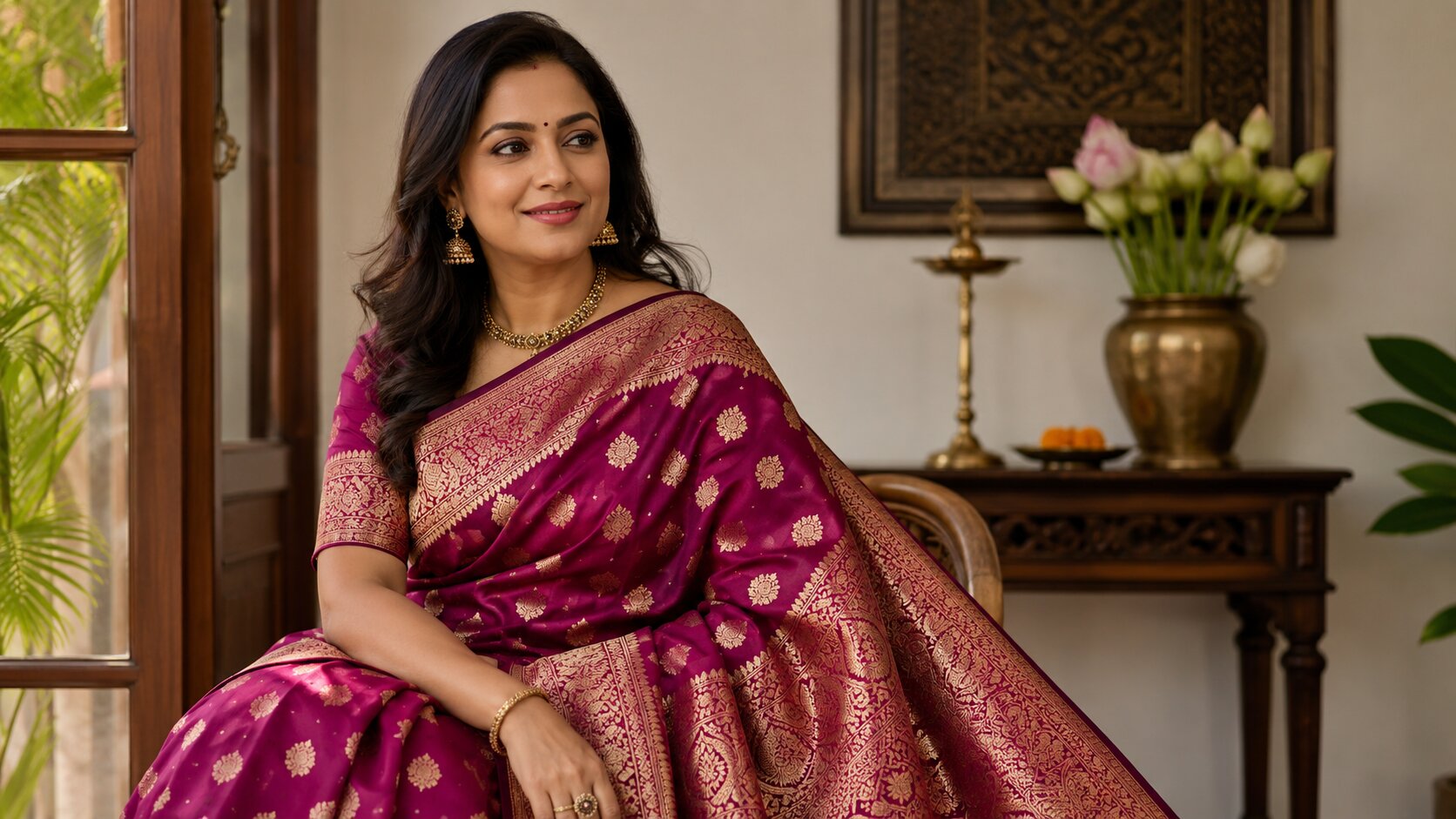
Banarasi Saree: India’s Most Iconic Weave With a Story That Spans Centuries
There is a saree in India that queens wore, brides swear by, and grandmothers still pull out of steel trunks like it is the most precious thing in the world. That saree is the Banarasi saree — and honestly, it has earned every bit of that reverence.
Whether you are a bride planning your trousseau, a saree collector, or just someone curious about why this one piece of fabric costs what it does. this guide covers everything. The history, the craft, the types, how to spot a fake saree, and why it still matters in 2025.
What Is a Banarasi Saree, Exactly?
A Banarasi saree is a handwoven silk saree made in Varanasi. The ancient city on the banks of the Ganga that goes by many names: Kashi, Banaras, Varanasi. The city is one of the oldest continuously inhabited cities in the world, and weaving has been part of its identity for millennia.
What makes a Banarasi saree distinctly Banarasi is the combination of fine silk, intricate zari work (gold and silver metallic threads), and motifs rooted in Mughal artistry. The result is a saree that is heavy, luminous, and undeniably grand.
And here is a legal fact most people do not know: since 2009, the Banarasi saree carries a Geographical Indication (GI) tag. This means only sarees woven in six specific districts of Uttar Pradesh — Varanasi, Mirzapur, Chandauli, Bhadohi, Jaunpur, and Azamgarh — can legally carry the Banarasi name. Think of it like Champagne. Not every sparkling wine is Champagne. Not every silk saree is a Banarasi.
A History That Goes Back Further Than You Think
Most people know Banarasi sarees as a Mughal-era creation. That is partly true but the full story runs much deeper.
References to fine Varanasi cloth appear in the Buddhist Jataka tales, the Ramayana, and the Mahabharata. The city’s weaving legacy stretches back nearly two to three thousand years, according to textile historians who have traced it through ancient texts and temple sculptures.
By the Gupta period, Kashi produced cloth so delicate it was described as resembling the shed skin of a snake. Writers from the seventh to ninth centuries referenced kanakgarbhita– cloth literally woven with gold wire as the preferred dress of aristocracy. That is the ancestor of the zari work you see on Banarasi sarees today.
Then came the Mughals, and things really took off.
The Mughal Influence
During the Mughal period around the 14th century, artisans in Banaras began developing elaborate silk brocades using gold and silver zari threads. The craft gained tremendous momentum when skilled weavers from Gujarat migrated to Varanasi – partly due to the famine of 1603 — bringing with them new techniques that merged with local traditions.
Persian-origin weaving families also settled in the region between the 15th and 17th centuries, introducing motifs like paisleys, intricate florals, and geometric patterns. Mughal emperors were known patrons of the arts, and their royal tastes directly shaped the designs that became signature Banarasi elements.
The Italian traveler Manucci, writing in his Storia do Mogor, noted that Banaras cloth worked in gold and silver was being exported across the world. By then, the Banarasi saree was not just clothing, it was a cultural statement.
How a Banarasi Saree Is Made
The process begins with the Naqshabandi. the creation of a design map inspired by medieval architecture, nature, and traditional motifs. The pattern is drawn on graph paper called a naqsha. Then comes yarn preparation: pure silk threads are dyed, starched, and set for weaving.
The actual weaving happens on traditional pit looms, where skilled artisans throw the shuttle across silk warp exactly as their fathers and grandfathers did before them.
Depending on the complexity of the design, a single Banarasi saree can take anywhere from 15 days to six months to complete. Heavily worked pieces with dense zari sometimes took a year in the old days. Every motif, every gold thread, every border detail placed by hand. That is not mass production. That is art.
Types of Banarasi Sarees
Not all Banarasi sarees look the same or feel the same. There are four main varieties, each with its own character:
1. Katan Silk (Pure Silk) The most traditional form. Woven from pure twisted silk threads, Katan Banarasi sarees have a structured drape and a natural sheen that ages beautifully.
2. Organza (Kora) Lighter than Katan, these use a mix of silk and zari on a sheer base. The result is an ethereal saree that works beautifully for summer weddings.
3. Georgette Soft, flowy, and more forgiving to wear. Georgette Banarasi sarees have become popular for everyday festive occasions. They are lighter and more comfortable for long events.
4. Shattir (Satin) Has a smooth, glossy finish. Less common but striking in its simplicity and sheen.
Beyond fabric, Banarasi sarees are also categorized by design style – Jangla (dense floral coverage), Tanchoi (fine, small patterns), Vaskat, Cutwork, Tissue, and Butidar (scattered motifs across the body).
The Motifs That Tell a Story
Look closely at a Banarasi saree and you will see more than just decoration.
The classic motifs include kalga and bel (intertwining floral-foliate patterns), jhallar (a row of upright leaves at the outer edge of the border), jaal (a net-like pattern that covers the body), and mina work (colored enamel-like detailing in the zari).
Common imagery includes peacocks, flowers, paisleys, elephants, and geometric forms. each pattern carrying centuries of cultural memory. These are not random design choices. They reflect the fusion of Persian aesthetics and Indian craftsmanship that defines the Banarasi tradition.
How to Identify an Original Banarasi Saree
Here is the honest truth: the market is flooded with machine-made imitations sold as “Banarasi.” Power looms can produce a replica fast and cheap. Knowing how to spot the real thing saves you money, and more importantly, supports the artisans who deserve it.
Check the reverse side. A genuine handwoven Banarasi saree will have loose thread floats between the warp and weft on the back. Machine-made copies have a clean, smooth finish on the reverse.
The silk burn test. Pull a few threads from an inconspicuous area and burn them. Pure silk smells like burnt hair and leaves powdery ash. Synthetic fiber smells like burning plastic and forms a hard bead.
Scratch the zari. Real zari has a red silk core coated with gold or silver. Scratch it gently if you see red, it is likely authentic. White threads underneath usually indicate fake zari.
Check the price. A handwoven Banarasi saree with real zari cannot realistically be “cheap.” If something seems too affordable to be true, it probably is a power loom piece. Authentic handloom sarees start from a few thousand rupees and can go significantly higher depending on the work.
The Banarasi Saree in Indian Culture
Ask any Indian bride what saree she wants, and nine times out of ten, a Banarasi comes up. It is the quintessential wedding saree paired with the finest jewellery, draped with ceremony, and often kept for life.
But the cultural role of the Banarasi saree goes beyond weddings. Mothers and grandmothers have historically collected Banarasi sarees from the moment a daughter is born, gifting them as heirlooms at marriage. Older Banarasi sarees, passed down through generations, are often considered more precious than new ones.
The Banarasi saree industry also sustains a significant economy. Over 1.2 million people directly or indirectly are connected to the handloom silk industry in and around Varanasi, including Gorakhpur, Chandauli, Bhadohi, Jaunpur, and Azamgarh districts. These are weavers, dyers, zari makers, and traders whose livelihoods depend on the craft surviving.
Challenges and the Road to Revival
The Banarasi saree has faced real threats. The rise of power looms and mass-produced textiles put traditional weavers under enormous pressure. Cheaper, faster imitations cut into the market share of handloom artisans who cannot compete on price alone.
However, the craft has fought back and is winning ground again.
Revivalist designers and brands like Sabyasachi, Raw Mango, Ekaya, and Tilfi Banaras have brought handwoven Banarasi sarees to the forefront of modern Indian fashion. They appear on global runways, celebrity wardrobes, and magazine covers. The GI tag of 2009 also gave weavers legal protection and market legitimacy.
Government initiatives, awareness campaigns, and a growing consumer preference for handmade, sustainable textiles have also contributed to the craft’s resurgence.
Why the Banarasi Saree Still Matters
Fashion trends come and go. The Banarasi saree has outlasted empires, famines, industrialization, and fast fashion.
It connects the wearer to a lineage of craft that has been practiced in the same city, on similar looms, for thousands of years. When you wear a handwoven Banarasi, you are wearing the latest expression of a tradition that dressed Mughal royalty and Buddhist aristocracy alike.
That is not nostalgia. That is history you can wear.
Final Thought
A Banarasi saree is not just a purchase. It is an inheritance from the artisan who spent weeks at the loom to the generations of weavers who kept this craft alive when everything pushed against them.
If you are buying one, buy handloom. Ask questions about the weave and the zari. Look at the reverse side. And support the real weavers of Varanasi who have been at this longer than most nations have existed.