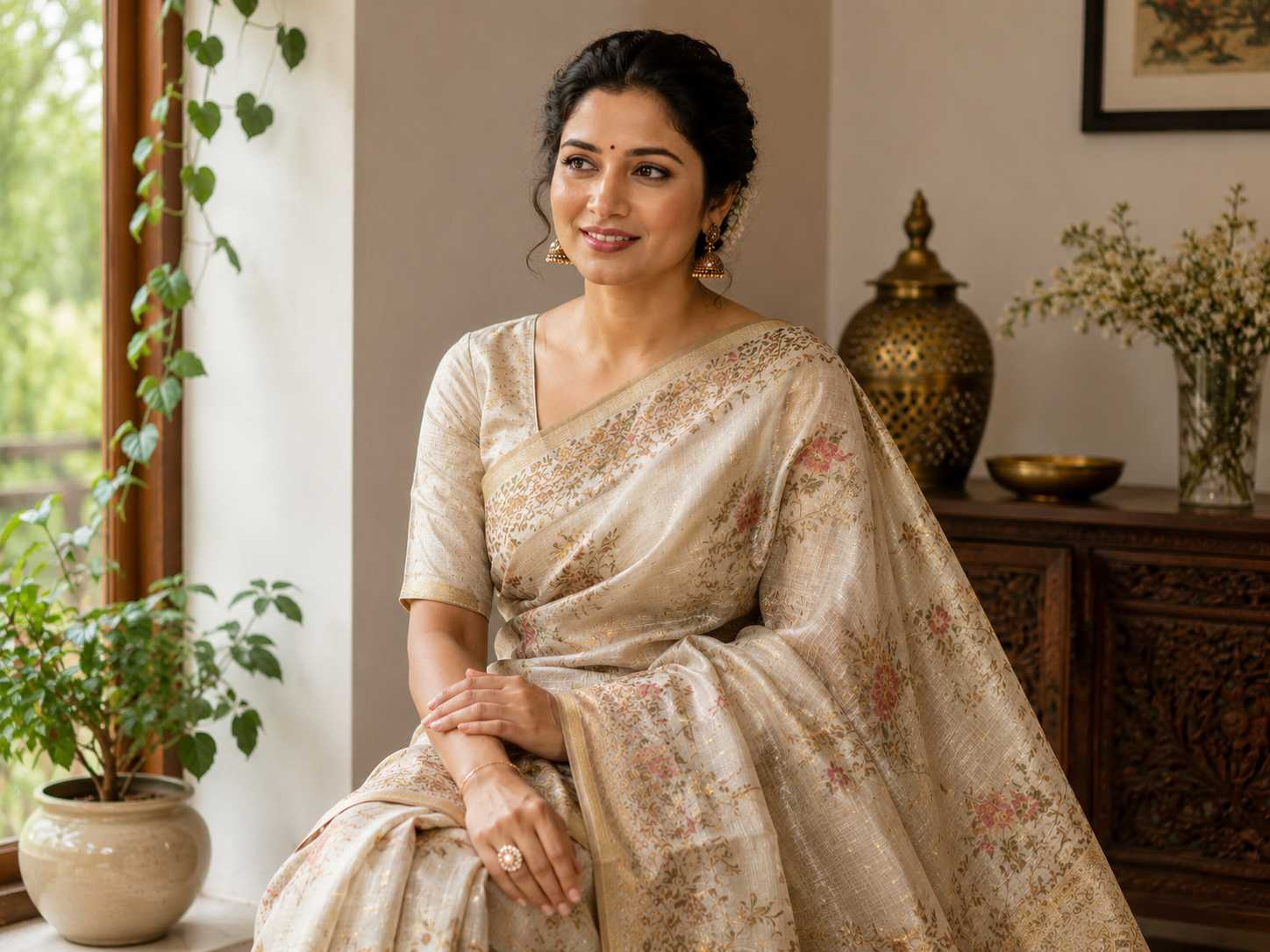
There’s a fabric so light, so breathtakingly sheer, that Mughal emperors once considered it a sign of divine artistry. We’re talking about the Chanderi silk saree a textile that has survived centuries, royal courts, and even the British industrial revolution, and still manages to steal hearts today.
If you’ve ever wondered what makes a Chanderi saree so special (or why a “cheap Chanderi” is almost always a red flag), this guide covers it all.
Where Did Chanderi Silk Come From?
The story of the Chanderi silk saree begins in a small, historic town called Chanderi, tucked in the Ashoknagar district of Madhya Pradesh. The town sits at the crossroads of two ancient cultural regions Malwa and Bundelkhand and that meeting point shaped everything about its textiles.
Weaving culture in Chanderi dates back to between the 2nd and 7th centuries. By the 13th century, around 1350 CE, Koshti weavers who migrated from Jhansi had settled in Chanderi and made it their home and their craft’s permanent address.
During the Mughal era, the craft hit its peak. Legend has it that at the time of Emperor Jahangir, Chanderi fabrics stretching over fifteen yards were so fine and delicate that they barely weighed a kilogram. That’s not a marketing line that’s history.
The Scindias, a prominent royal family, further patronized the craft in 1910, protecting the weaver community and ensuring the tradition survived industrialization. Today, the town is home to over 3,600 active looms, with women playing an active role in weaving.
Kanjivaram Saree: The Queen of Silks That Has Stood the Test of Time
What Makes Chanderi Silk Sarees Different?
Let’s be honest India has hundreds of saree varieties. So why does Chanderi hold such a special place?
The answer lies in three things: the fabric’s legendary lightness, its natural sheer texture, and the intricate zari work that makes it shimmer without feeling heavy.
Chanderi sarees are produced from three types of fabric: pure silk, Chanderi cotton, and silk-cotton blends. Each brings something different to the table.
In the weaving process, silk is used for the warp (called “Tana”) and cotton for the weft (called “Bana”). The silk threads are so fine that weavers traditionally place trays of water beneath the loom to help identify individual gossamer strands. That’s not technique that’s devotion.
The motifs peacocks, coins, lotuses, florals, and geometric patterns aren’t printed on top. They’re woven directly into the fabric, making them a permanent part of the saree rather than a surface decoration.
Types of Chanderi Silk Sarees
Not all Chanderis feel the same on the shoulder. Knowing the types helps you choose the right one.
Pure Silk Chanderi :— Both warp and weft in silk. The most luxurious and expensive variety. It has the richest sheen and is ideal for weddings and grand celebrations. Prices for pure silk Chanderi sarees typically start around ₹6,000 and can go well above ₹1,00,000 depending on the zari and design intricacy.
Silk-Cotton Chanderi :— The most popular type. Silk gives the shine; cotton gives the breathability. It sits in a sweet spot — lightweight, elegant, and wearable across seasons. A practical choice for festive occasions and semi-formal events.
Pure Cotton Chanderi :— Made entirely from fine hand-spun cotton yarn. Breathable, soft, and perfect for summers or office wear. GI-certified cotton Chanderis start around ₹2,500.
Tissue Chanderi :— Woven with silk and zari threads, this variety has a shimmering, almost ethereal appearance. Popular for evening events and upscale celebrations.
The GI Tag: Why It Matters More Than You Think
In 2005, the Indian government awarded Chanderi fabric a Geographical Indication (GI) tag — making it the country’s 4th GI-protected product.
What does this mean in plain language? Only fabric handwoven by artisans in Chanderi, Madhya Pradesh, using heritage techniques, can legally be called Chanderi. A machine-made cotton-silk saree produced in Surat — however beautiful — is not Chanderi. Labeling it as such violates the GI rights of real Chanderi artisans.
The Indian market is, unfortunately, flooded with machine-made imitations sold under the Chanderi name. Prices that seem too good — anything under ₹2,000 for a full saree — are almost certainly mill-made, not handwoven. Buyer awareness is the first line of defense.
Always look for the Handloom Mark and the GI Tag on any Chanderi saree you purchase. These certifications confirm that your saree is genuinely handwoven in the Chanderi region using traditional techniques. You can also verify a product’s GI status through the official Intellectual Property India portal at ipindia.gov.in.
How to Identify an Original Chanderi Silk Saree
This is where most buyers go wrong and where sellers of fake Chanderis make their money. Here’s a practical checklist.
The Light Test Hold the saree up against a light source. Authentic Chanderi silk has a distinct, subtle transparency with a natural glow. Fake versions either look unnaturally sheer or feel stiff and opaque.
The Touch Test A pure Chanderi saree feels soft despite a slightly crisp finish. It’s dramatically lighter than standard silk sarees. If it feels heavy for its size, be cautious fake versions often use thicker yarns or synthetic blends to cut costs.
The Motif Test Run your fingers over the design. If it feels flat and print-like, it’s probably not a genuine handwoven piece. Authentic Chanderi motifs peacocks, coins, florals, geometric patterns are woven into the fabric, so you can feel them on the reverse side too.
The Zari Test Real zari (gold or silver thread) has a rich, natural shimmer. Synthetic zari looks plasticky, fades quickly, and sometimes flakes off. If it glitters like a festival decoration, walk away.
The Imperfection Test This one surprises people. Genuine handwoven sarees have tiny, natural irregularities in the weave and motifs. These aren’t defects they’re proof of a human hand at work. Power-loom copies are machine-perfect, and that uniformity is actually the giveaway.
The Price Test If the price seems too good to be true, it almost always is. Pure silk Chanderi starts around ₹6,000 from trusted sources. A seller offering “authentic pure Chanderi silk” for ₹1,500 is either misinformed or misleading you.
How to Care for Your Chanderi Saree
You’ve invested in a genuine piece now make it last.
- Dry clean pure silk Chanderis, especially those with heavy zari work.
- Cotton Chanderis can be hand-washed gently in cold water. Do not wring. Press water out softly with a towel.
- Dry in shade. Direct sunlight dulls colors over time.
- Iron on low heat from the reverse side. Never iron directly on the zari.
- Store in muslin or cotton cloth, not plastic bags. Plastic traps moisture and damages the fabric.
Treated with care, a genuine Chanderi saree can stay beautiful for decades. Many families pass them down as heirlooms which tells you everything about their durability when handled properly.
Chanderi Saree Styling: Less Is More
Chanderi’s elegance is its subtlety. It doesn’t need a lot of help to look spectacular.
A good rule to follow: if your saree is sheer and delicate, let one element stand out either the blouse, the earrings, or the border. Not all three at once. The fabric itself is doing the work.
For office or casual wear, choose a cotton-silk Chanderi in a solid or small motif with a plain blouse. For weddings or festive events, pure silk or tissue Chanderi with a contrasting blouse and minimal jewellery is genuinely hard to beat. Chanderi dupattas also pair beautifully with kurta sets and contemporary fusion outfits.
Why Buying Genuine Chanderi Matters
Over 60% of the population in Chanderi town is involved in the production of this textile. When you buy an authentic, handwoven Chanderi saree, you’re not just purchasing a piece of clothing you’re directly supporting weaver families who have kept this craft alive for over seven centuries.
The Chanderi saying goes: “Shahar Chanderi Mominwara, Tiria Raj, Khasam Panihara” — roughly meaning that in Chanderi’s weaver quarters, the wives rule and the husbands draw water. Why? Because weavers must keep their hands soft, and so traditionally women took on the physical household tasks. It’s a quirky, charming window into a culture where the craft dictates the lifestyle.
Buying authentic isn’t just an ethical choice. It’s an investment in a living heritage.
Final Word
The Chanderi silk saree is not just a garment. It’s a 700-year-old conversation between craft, culture, and commerce. From Mughal courts to modern fashion weeks, it has stayed relevant because it deserves to be.
The next time you’re shopping for a Chanderi, check the weight, hold it to the light, feel the motifs, and look for that GI tag. You’re not being fussy — you’re being smart.
And honestly? A fabric that survived Mughal emperors, British industrialization, and mass-market competition deserves a little due diligence before it lands in your wardrobe.