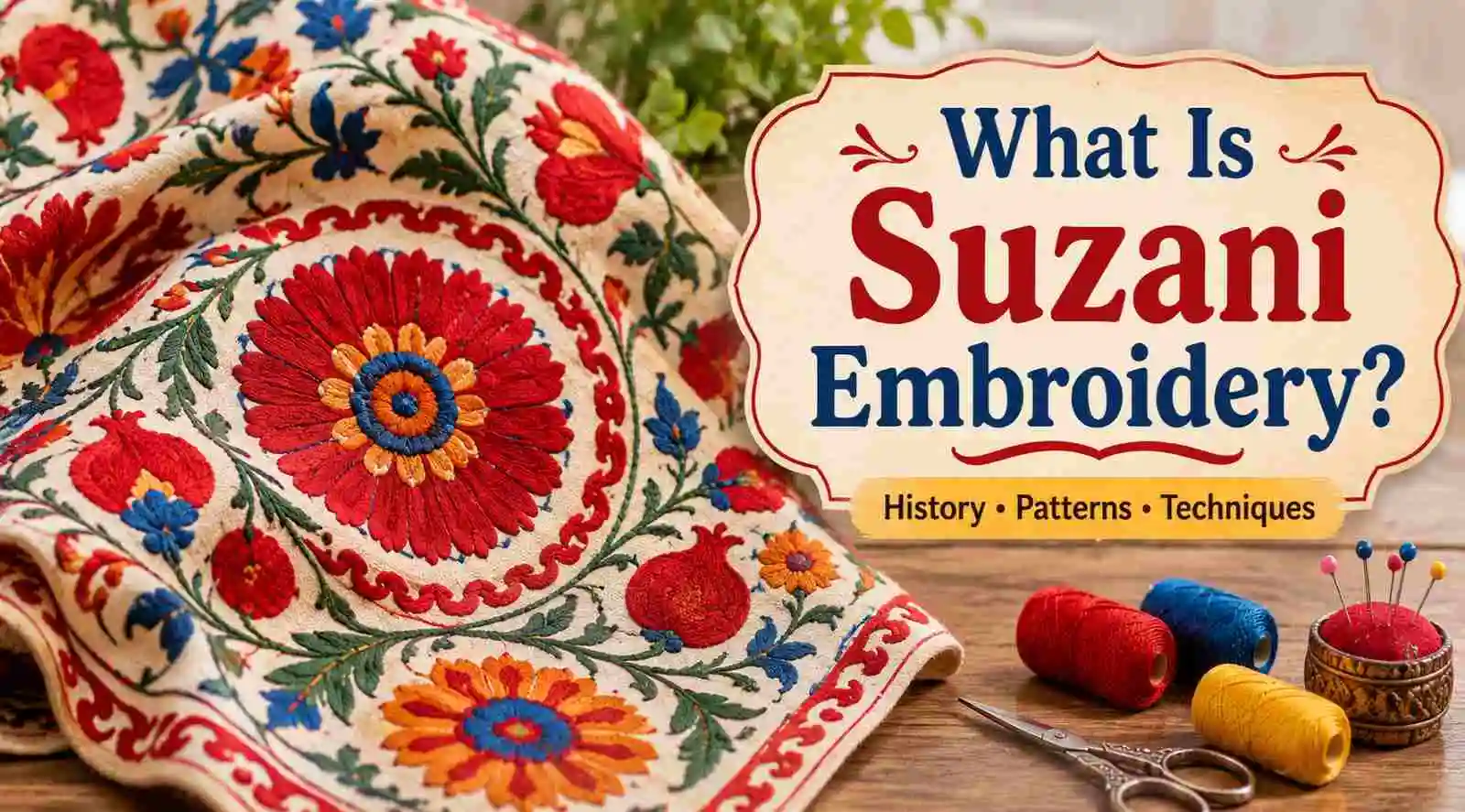
Suzani comes from the Persian word for needle, and suzani embroidery is the large hand-stitched cloth that carries the name. A typical piece is around a metre and a half wide, covered in silk-thread flowers, vines and sun-like discs. It comes from Central Asia, and the region most associated with it is what is now Uzbekistan.
You’ll often see suzanis sold as “nomad” textiles that hung in yurts. That’s partly true, but a 2003 Saudi Aramco World article on suzanis says most of the pieces that survive today come from villages and cities, and were made at home for the family’s own use. The nomad label is easy marketing. The household story is better documented.
A dowry that took years to finish
Suzanis began as wedding preparation. When a daughter was born, her mother started embroidering textiles for the future dowry, and the girl joined in as soon as she could hold a needle, according to the same Aramco article. The main piece was often a bed cover for the marriage. By the end of the 19th century, suzanis were also being hung on walls.
Christie’s, in a collecting guide, adds that the bride and her mother gave the cloth to the groom on the wedding day, and its symbols were meant to bring luck, health and a long life. It also showed the community what the women of the family could do. Aramco says girls built dowries to prove their skill and industriousness.
Not everyone drew their own design. The pattern often came from a kalamkash, an older woman who worked as the local designer. Cloth was brought to her, and she inked the outlines straight onto it. On worn old pieces, Aramco says, you can sometimes see those pen lines where the silk has rubbed away.
Then the family split the work. A suzani is usually built from four to six narrow strips of cotton, with linen or silk as alternatives, and different relatives embroidered the strips before someone sewed them together. That’s why a close look at an old piece often shows patterns drifting slightly out of line, or one strip a shade different from the next. Natural dye batches never match exactly.
Some women also added a personal touch that ignored the planned colour scheme.
How a suzani is stitched
The stitches are simple. Aramco lists couching (basma, plus a slanted version called kanda khayol), chain stitch (tambur) and a double buttonhole stitch (ilmok) for outlines. Christie’s counts four stitches in all. Either way, the vocabulary is small and the effect is large, because everything is worked densely in silk thread.
Makers of early pieces used natural cotton or linen. Coloured grounds in yellow, pink or violet seem to be a later fashion, and silk grounds go with groups such as the Lakai.
Old suzanis used natural dyes: indigo from India for blue, cochineal and madder for red, saffron for yellow, and pomegranate skins or pistachio galls with iron for black. By the last quarter of the 19th century, Aramco says, harsh artificial dyes were flooding in and quality dropped almost at once. So it’s easy to tell whether a suzani predates the change or not, just by looking at the colour.
Also Read:
7 Popular Suzani Embroidery Motifs and Their Meanings
How to Make Embroidery Hoop Art
Reading the pattern
A great many suzanis are about flowers, but the symbols vary by region.
In the Tashkent, Pskent and Fergana Valley areas, the centre of the cloth often holds a big round motif called a palak, a heavenly orb. It can look like a sun, a moon or a giant red flower, and specialists still argue about which. The word is so tied to Tashkent that people there use it instead of suzani. Aramco adds that this flower-and-sun roundel also shows up in embroidery from Rajasthan and Gujarat and in Kashmir, where it stands for power and fertility.
Nurata suzanis tend to carry a central star and scattered flower sprays on a natural cotton ground, usually in muted indigo and rust. Shakhrisabz pieces are lush, with flowers in a rich range of colours. Bukhara work leans toward dense floral lattices.
Other motifs recur across the region. Pomegranates and tulips are common, along with irises, vines and the occasional fish or bird. The teardrop-shaped botah, which reached the region from Persia, may be a version of a tree-of-life design.
Christie’s says people believed these motifs gave a cloth protective power. Aramco adds that some meanings have faded, such as the Buddhist meaning of a stylised lotus.
If it looks familiar, it might be
If you know Indian embroidery, parts of suzani will look familiar. The western group of suzanis, Aramco says, often shows the influence of textiles that came from Mughal India through Kashmir. The cloth also travelled the other way: some patterns went west in the 17th century and became the basis for English Jacobean embroidery.
That doesn’t make suzani an Indian craft. Its roots run through Silk Road cities, and some motifs go back much further. Wealthy Bukhara families saw imported Kashmir shawls, according to HALI magazine’s editors, and borrowed from them.
Not every suzani is a bedspread
Smaller pieces had their own names. A bolim posh is a square canopy held over the couple at a wedding.
A jai-namaz is a prayer cloth with an empty centre standing for the mihrab, the prayer niche. A sandaliposh covers a brazier. A nim suzani is any small one, since there’s no fixed size.
Old, new and machine-made
The oldest surviving suzanis date from the late 18th and early 19th centuries, though both Aramco and Christie’s suspect the tradition is older. A Shahrisabz suzani from around 1870, worked on seven panels, sold at Christie’s London in October 2025 for £27,940. That’s a lot of money for something made as household linen.
The twentieth century was rougher on the tradition. Aramco says the Bolsheviks discouraged dowries, girls went to school instead of the needle, and the generation for whom every stitch was a prayer began to die out. A travel firm, Transindus, takes a more hopeful line and says suzani held up well under Soviet cultural suppression. Both readings are probably partly right: the meaning thinned, and the stitching carried on.
Today suzanis are sold everywhere in Uzbekistan, to locals and tourists alike. Some are hand-embroidered. Others are machine-made, as Aramco notes, so if you buy a new one, ask which you’re getting.
Christie’s says fakes aren’t a big problem for antiques, since suzanis rarely sell for enough to tempt forgers. That sits oddly beside the price above, but it’s the auction house’s view. It adds that modern pieces are easy to spot because synthetic dyes look flat. For an old one, unaltered condition and fresh colour matter more than anything else.
If you do own one, Christie’s advice is to hang it flat and never wash it yourself, because old cloth can be very fragile. A textile conservator is the person to call.
If you want to stitch your own
Start with chain stitch. You probably know it already, and suzani makers used it to outline their designs. Draw one palak-style circle on plain cotton, outline it in chain, and fill the inside with rows of the same stitch before you think about borders or vines.
Sources
- Splendid Suzanis, Saudi Aramco World (2003): size, strips, kalamkash, stitches, dyes, motifs, regional styles, Soviet era, modern production.