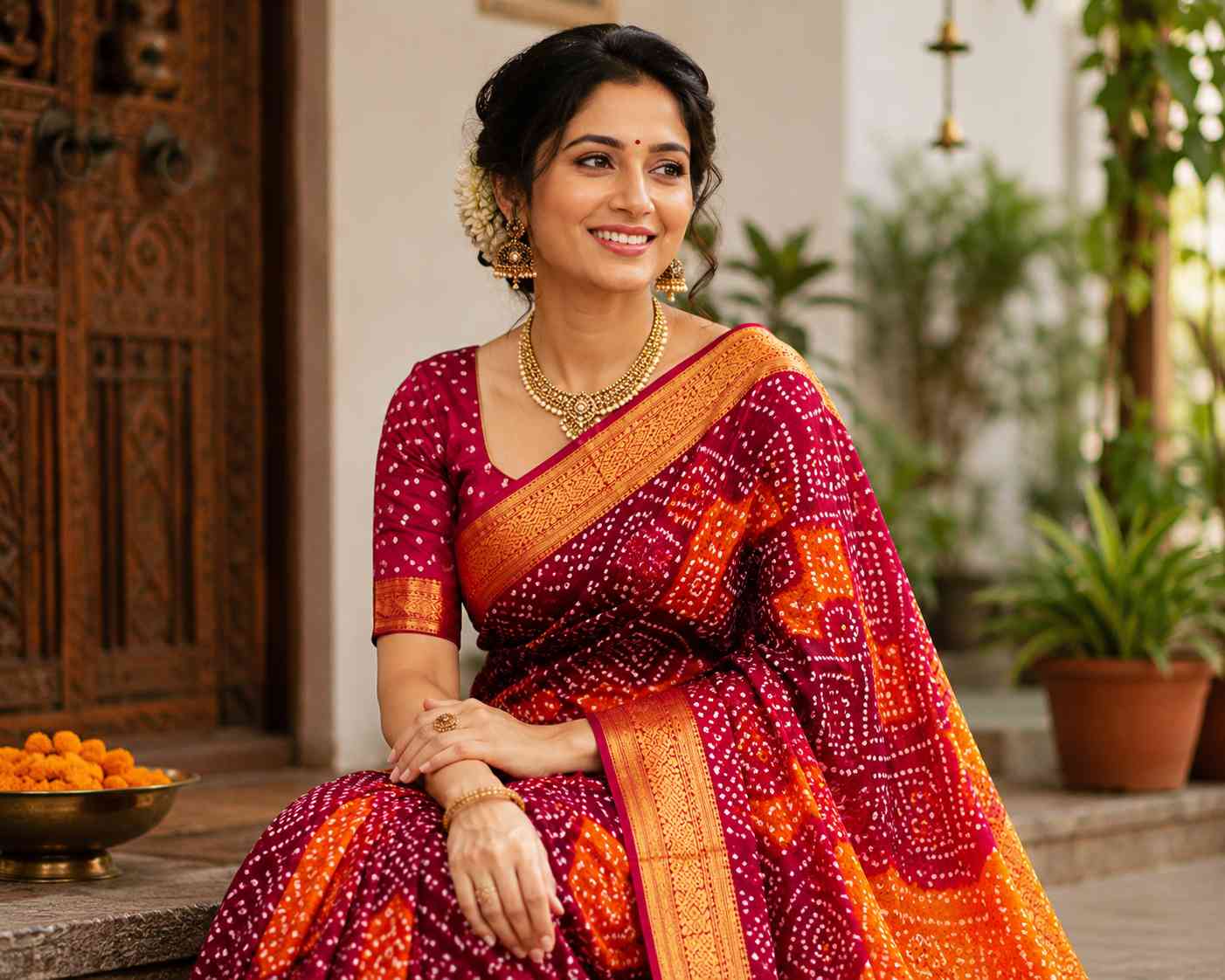
If a piece of fabric could tell stories, the Bandhani silk saree would fill an entire library. Dotted with thousands of tiny knots, soaked in vivid colours, and passed down through generations of skilled artisans, this is not just a saree. It is living history draped around a woman’s shoulders.
And yes, it is every bit as stunning as it sounds.
What Is a Bandhani Silk Saree?
The word Bandhani comes from the Sanskrit root “bandh,” which simply means “to tie” or “to bind.” That etymology tells you everything. The fabric is made by pinching very small portions of cloth and tying them with thread into many tiny bindings that form a figurative design — creating an intricate pattern of dots. The cloth is then immersed in different dye vats to produce bright, beautiful colours.
When you combine this ancient tie-dye technique with the natural sheen of silk, you get a Bandhani silk saree — a textile that manages to look both handcrafted and incredibly refined at the same time.
Mysore Silk Saree: History, Craftsmanship, and Everything You Need to Know Before Buying
A History That Puts Most Things to Shame
Here is a fun fact to bring up at your next dinner party: your Bandhani saree is older than most civilisations people casually discuss.
The Bandhani tie-and-dye technique originated roughly 5,000 years ago in the Khatri community of Kutch, Gujarat. The earliest traces of Bandhani textile go as far back as 4000 B.C., during the Indus Valley Civilization.
That is not a typo. Four thousand years before Christ, someone in the Indian subcontinent was pinching fabric and tying knots to create patterns. Humans were still figuring out basic metallurgy, and artisans in Gujarat were perfecting textile art.
Even the carved walls of the Ajanta Caves show traces of Bandhani sarees. The 6th-century paintings depicting the life of Buddha feature figures dressed in Bandhani cloth — proof that this craft has been revered for millennia.
The first Bandhani saree on recorded historical occasion was worn at the time of Bana Bhatt’s Harshacharita, on the occasion of a royal marriage — meant to bring good fortune to the new bride. So if you were wondering whether a Bandhani silk saree is appropriate for weddings, history has already answered that question.
Where Does Bandhani Silk Come From?
Bandhani is believed to have originated from the state of Gujarat. The Khatri community of skilled dyers and printers became its primary practitioners, and they remain so even today.
Towns such as Sikar, Jaipur, Udaipur, Bhilwara, Ajmer, and Jamnagar are well-known centres that produce world-class Bandhani sarees. Rajasthan and Gujarat are the two heartlands of this craft, though its influence has stretched to Sindh, Punjab, and Tamil Nadu (where it goes by the name sungudi).
The city of Bhuj and Jamnagar is particularly famous for its red Bandhani sarees, as the quality of water available there helps add remarkable sharpness to the red-colour palette. Yes, even the local water plays a role. That is how deeply rooted this craft is in its geography.
How a Bandhani Silk Saree Is Made
Making a Bandhani silk saree is not a weekend project. It is a slow, painstaking labour of love — and the results prove it.
Here is how the process works, step by step:
1. Fabric Selection High-quality silk is chosen for its natural shine and durability. Craftsmen then mark tiny dots on the fabric according to traditional patterns.
2. Binding Small portions of the fabric are pinched and tightly tied with thread to resist dye. The tied fabric is then immersed in vibrant dyes, often starting with lighter colours.
3. Multi-Stage Dyeing For multi-coloured designs, the fabric undergoes repeated tying and dyeing. After drying completely, the threads are carefully removed to reveal the pattern.
4. The Big Reveal The saree is often kept with its ties intact so that the buyer can enjoy watching it unfold for the first time — a moment of pure theatre.
Now here is the part that should make your jaw drop slightly: a single Bandhani saree can contain thousands of tiny knots, taking up to two months to complete by an individual artisan. Traditional artists can tie as many as 700 knots per square inch for ultra-premium Bandhani sarees.
Seven hundred knots. Per square inch. By hand.
The next time someone questions the price of an authentic Bandhani silk saree, just read that sentence to them.
The Silk Factor: Why It Makes All the Difference
Traditionally, Bandhani was created on cotton and muslin. With changing times and the need for innovation, producers began making Bandhani on georgette, silk, cotton-silk, viscose and other fabric variants. Each fabric has a unique nature, so the effect of this art varies according to the fabric used.
Silk, however, brings something special to the table — or rather, to the saree. The natural lustre of silk amplifies the vibrancy of Bandhani’s colours. The dots seem to shimmer. The drape becomes fluid and graceful. It elevates a craft that was already extraordinary into something genuinely luxurious.
Gajji silk is a popular fabric used to make bridal Bandhani sarees, while the rich Banarasi Bandhani sarees are made on Katan silk and adorned with elaborate motifs woven in gold or silver zari threads.
Types of Bandhani Silk Sarees Worth Knowing
Not all Bandhani silk sarees look the same. The craft has evolved into several distinct styles, each with its own personality.
Gharchola Bandhani This style features grid-like patterns with intricate motifs in each square, originating from Gujarat’s Saurashtra region. It is traditionally gifted at weddings.
BorJaal Bandhani Highly popular among Marwari communities, this type is meant for traditional nuptial ceremonies. Its name comes from the extremely fine mixture of colours and dots that creates a maze-like effect.
Jhankaar Bandhani A very colourful and gleamy style with extreme intricate design patterns. Unlike other Bandhani sarees that have white or light-coloured dots, Jhankaar Bandhani uses red or maroon dots against the base colour.
Banarasi Bandhani An amalgamation of Banarasi heritage and the ancient tie-and-dye technique from Gujarat and Rajasthan. The Banarasi Bandhej saree is adorned with gold zari work, producing a combination that many consider unmatchable in grandeur.
The Colour Language of Bandhani
In Bandhani, colours are not just aesthetic choices. They carry meaning.
Each colour in Bandhani has a specific significance: red symbolises marriage, yellow represents spring, saffron denotes sanctity, and black offers protection.
Bandhani usually begins with lighter hues — yellow comes first, followed by reds, maroon, ochre, tangerine, indigo blues, turquoise, and deep greens. Nowadays, other shades like purple, mustard yellow, beige, pink and even black are also included in the Bandhani palette.
This is why a Bandhani silk saree always feels emotionally charged. You are not just wearing a colour — you are wearing an intention.
When to Wear a Bandhani Silk Saree
Bandhani silk sarees are popular among brides-to-be and are also worn at pujas, Diwali, Dussehra, and other festive ceremonies.
It is considered auspicious for mothers to gift Bandhani sarees to their daughters when they are getting married. Often, the mother of the bride herself wears the traditional Bandhej saree for the wedding ceremony.
In short: if you are going somewhere important, a Bandhani silk saree fits. Wedding? Yes. Festival? Absolutely. Family puja? Without question. That dinner where you want everyone to quietly wonder where you got it? Perfect.
How to Care for Your Bandhani Silk Saree
A saree this precious deserves proper care.
Dry cleaning is recommended for the initial washes. For hand washing, use a gentle, pH-neutral detergent, avoid vigorous rubbing, and rinse thoroughly in cold water.
Do not use an iron at high temperature on Bandhej work, and do not expose the saree to direct sunlight, as this can cause fading.
Use a low-heat setting with a pressing cloth when ironing. Store sarees in a cool, dry place, away from direct sunlight, to prevent fading and damage.
Treat it well, and it will last decades — maybe long enough to become a heirloom.
How to Identify an Authentic Bandhani Silk Saree
The market is full of machine-made imitations. Here is what separates the real from the replica.
Check the knots. On an authentic Bandhani saree, the ties are left intact at the time of sale. The dots are three-dimensional and slightly raised — not flat prints.
Look at the reverse side. In genuine Bandhani, the dot pattern is visible on both sides of the fabric, because the dye penetrates through.
Feel the texture. Handcrafted Bandhani has a natural irregularity that machines cannot replicate perfectly. That slight inconsistency is the signature of a human hand.
Buy from trusted sources. Select online platforms that specialise in handmade textiles, which directly support artisan communities and can verify the authenticity of what they sell.
A Craft Worth Protecting
Making a Bandhani silk saree is the primary source of livelihood for many families. It takes skill, hard work, and ample time to create even a single piece.
Bandhani tying is often a family trade, with women of these families working at home to tie the patterns. In Gujarat, the Bandhani work has been exclusively carried out by the Khatri community of Kutch and Saurashtra for generations.
When you buy an authentic Bandhani silk saree, you are not just buying fabric. You are supporting a family, preserving a tradition that survived the Mughal Empire, colonisation, industrialisation, and fast fashion — and keeping a 5,000-year-old story alive.
That is a lot of weight for six yards of silk to carry. And it carries it beautifully.