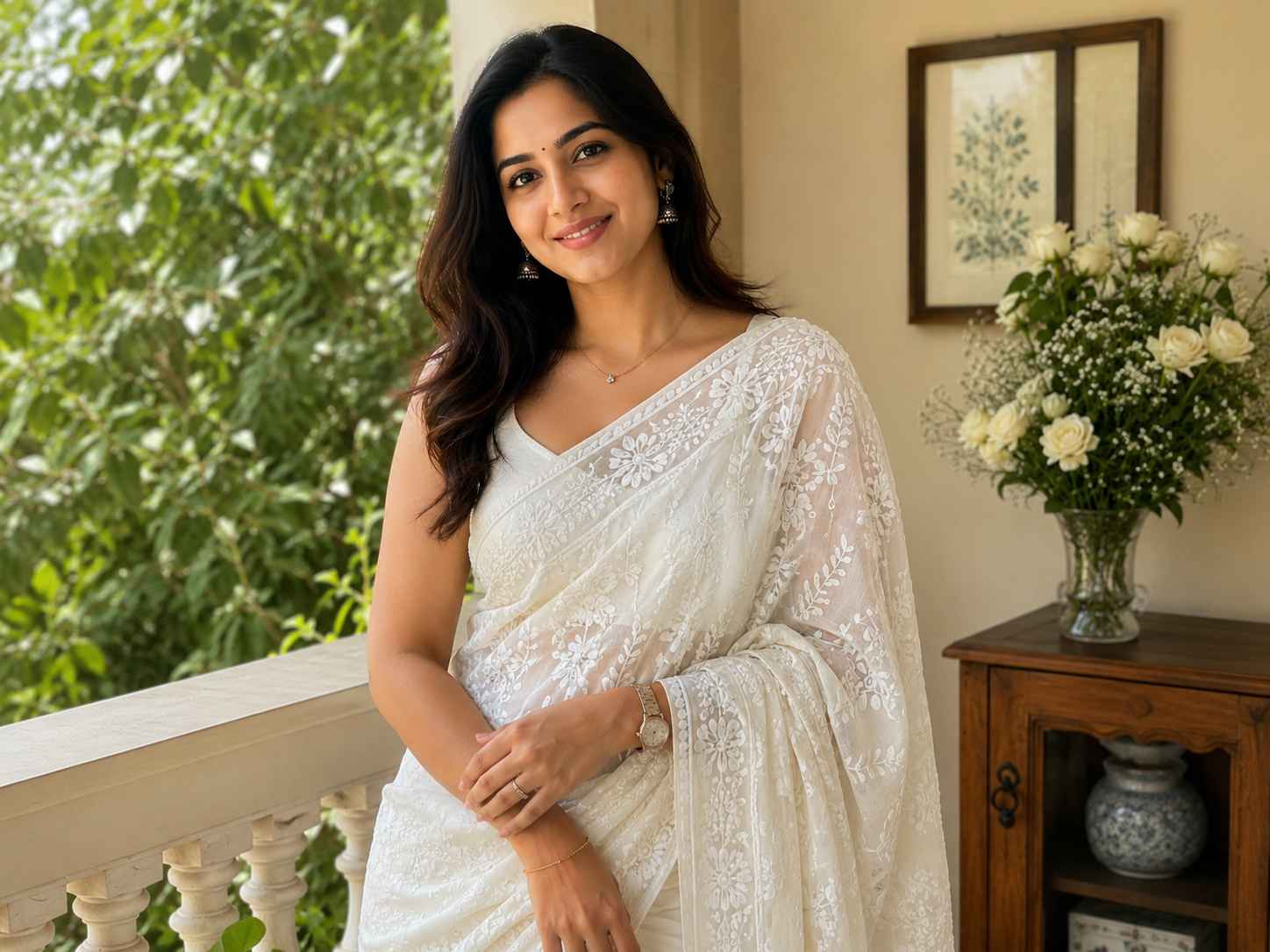
Chikankari saree One is fabric. The other is a story — stitched by hand, soaked in history, and refined across four centuries of Indian craftsmanship. If you’ve ever run your fingers over the delicate floral embroidery of a Chikankari saree and felt something, you weren’t imagining it. That feeling has a name. It’s called heritage.
Let’s talk about what makes this embroidery style so extraordinary — and why it still matters in 2026.
What Is a Chikankari Saree?
A Chikankari saree is a hand-embroidered saree that originates from Lucknow, Uttar Pradesh. The word “Chikan” comes from the Persian word Chikin, which simply means “embroidered fabric.” But trust us, there’s nothing simple about what goes into making one.
The craft involves embroidering fine fabric — traditionally white muslin — with white thread using over 32 distinct hand stitches. The result is a play of texture, shadow, and light that no machine can replicate. You read that right: 32 stitches, each with a different name, technique, and visual effect.
Try doing that on a Monday morning.
Bandhani Silk Saree: The Art That Has Survived 5,000 Years (and Still Turns Heads)
A History Rooted in Royalty
Chikankari embroidery dates back to the Mughal era. The most widely accepted origin story credits Empress Nur Jahan, wife of Emperor Jahangir, with introducing this craft to India in the 16th–17th century. She encountered similar needlework traditions in Persia and brought skilled artisans to the Mughal court, encouraging Indian craftspeople to learn and adapt the style.
Under her patronage, Chikankari became a symbol of royal elegance — created exclusively for Mughal royalty on their finest muslin garments.
When the Mughal Empire declined, the Nawabs of Awadh picked up the baton. Under their patronage in the 18th century, Chikankari flourished in Lucknow and became deeply woven into the city’s cultural identity. Lucknow — already famous for its kebabs, poetry, and tehzeeb (refined culture) — now had another reason to be proud.
Even Wikipedia references embroidery similar to Chikankari work as far back as 3rd century BC, when Greek historian Megasthenes mentioned Indians using flowered muslins. History, people. This craft has been around longer than most empires.
The GI Tag: Official Stamp of Authenticity
In December 2008, the Geographical Indication Registry of India accorded Chikankari the prestigious GI (Geographical Indication) tag. This means only products made in the Lucknow region using traditional techniques can legally be called “Chikankari.”
Think of it like Champagne — you can make sparkling wine anywhere, but only Champagne from Champagne is Champagne. Same logic applies here.
This tag protects artisans from cheap imitations and ensures buyers get the real deal when they invest in an authentic Chikankari saree.
How a Chikankari Saree Is Made
The creation of a Chikankari saree involves three core stages:
1. Block Printing The chosen design is first block-printed onto the fabric using washable ink. Most motifs draw inspiration directly from Mughal-era patterns — florals, paisleys, creeping vines, and birds.
2. Embroidery Here’s where the magic happens. Skilled artisans stitch the printed design by hand using traditional stitches. Each stitch has a different purpose and visual outcome. A few notable ones include:
- Tepchi — a simple running stitch, the foundation of most Chikankari work
- Bakhiya — also called “shadow work,” embroidered on the wrong side so the shadow shows through on the front
- Murri — tiny French knots shaped like rice grains, considered the oldest and most sought-after stitch
- Jali — an open lattice-work where the thread is never drawn through the fabric, so both sides look equally beautiful
- Hool — a fine eyelet stitch, often used for flower centers
3. Washing Once the embroidery is done, the saree is carefully washed to remove all traces of the block-printed guide pattern. What remains is pure, clean embroidery that speaks for itself.
The entire process can take anywhere from a few days to several weeks — depending on the complexity of the design. A single artisan family in Lucknow may spend an entire month on one saree. That’s not slow. That’s devotion.
Types of Chikankari Sarees
The Chikankari saree has evolved beautifully over the centuries. What started as white-on-white embroidery on muslin now exists across a range of fabrics and styles.
By Fabric
- Georgette Chikankari Saree — lightweight, flowy, perfect for summer events and weddings
- Cotton Chikankari Saree — breathable, ideal for daily wear and casual occasions
- Silk Chikankari Saree — rich and luxurious, perfect for formal celebrations
- Net Chikankari Saree — sheer and glamorous, a popular choice for parties
- Organza Chikankari Saree — crisp yet delicate, increasingly popular for festive occasions
By Design
- Floral Chikankari — the classic choice, featuring delicate floral motifs across the fabric
- Jaal Chikankari — an all-over lattice pattern that creates a stunning, dense visual effect
- Buti Chikankari — scattered small motifs across the saree for a subtle, elegant look
- Peacock Chikankari — peacock motifs symbolizing grace and beauty, a favourite for weddings
By Color
Traditional Chikankari sarees feature white embroidery on white or pastel fabric. Today, you’ll find them in soft blush pinks, mint greens, lavenders, bold reds, and even contemporary jewel tones — all without losing the essence of the craft.
Why Women Still Love Chikankari Sarees
Honestly? Because it checks every box.
A Chikankari saree is breathable enough for Indian summers, elegant enough for weddings, and versatile enough for both — sometimes in the same week. It’s the kind of wardrobe investment that doesn’t go out of style because it was never following a trend to begin with.
Here’s what makes it genuinely special:
- Each piece is unique. No two hand-embroidered sarees are identical. The human hand simply doesn’t repeat itself the way a machine does.
- It’s sustainable by nature. Traditional handcraft, slow production, natural fabrics. Chikankari was doing “slow fashion” before the term existed.
- It carries cultural weight. Wearing a Chikankari saree connects you to four centuries of artisanal tradition. That’s not marketing copy — that’s fact.
- It supports real livelihoods. Chikankari is reportedly the main income-generating activity for thousands of families in Lucknow, providing livelihoods to artisans across the region.
How to Style a Chikankari Saree
Styling a Chikankari saree is actually one of the easier fashion decisions you’ll make — because the saree does most of the work.
Keep jewelry traditional. Jhumkas, chandbalis, and polki necklaces complement the delicate embroidery without competing with it. Heavy statement jewelry tends to clash with the subtlety of Chikankari.
Choose your blouse wisely. A well-fitted blouse in a matching or complementing shade elevates the entire look. Many women pair a Chikankari saree with a solid silk blouse for contrast.
Let your hair do less. Simple buns, soft braids, or a low chignon work beautifully. The idea is to let the saree breathe and be seen.
For modern looks, pair a Chikankari saree with minimalist block heels, a small clutch, and simple gold hoops. Contemporary, clean, and still unmistakably elegant.
Chikankari on the Global Stage
Chikankari is no longer just a Lucknow story. The craft has appeared on runways in London, Paris, and New York, attracting attention as a symbol of artisanal luxury and sustainable fashion. As the global fashion industry shifts toward conscious consumerism — buyers choosing pieces with provenance and purpose over fast, disposable fashion — Chikankari has found a brand-new generation of devoted admirers far beyond India.
Countries in the Middle East, Southeast Asia, the United States, and Europe have all emerged as significant markets for Chikankari products. This isn’t a passing trend. It’s a reckoning.
How to Identify Authentic Chikankari
With demand rising, imitation products have entered the market. Here’s how to tell real from fake:
- Check the reverse side. Authentic hand-embroidered Chikankari shows visible thread work on the back. Machine-made pieces look identical on both sides.
- Look for inconsistency. Oddly enough, slight imperfections are a good sign. Hand stitching has natural variations that machines don’t.
- Ask about the GI tag. Genuine Lucknowi Chikankari should trace its origin to artisans in the Lucknow region.
- Feel the fabric. Authentic Chikankari on quality fabric has a specific weight and drape — a certain presence — that synthetic imitations simply can’t mimic.
Caring for Your Chikankari Saree
A Chikankari saree is an investment. Treat it like one.
- Always dry clean or hand-wash in cold water with mild detergent
- Never wring the fabric — press gently and let it air dry in shade
- Iron on low heat from the reverse side, or use a cloth between the iron and embroidery
- Store in a muslin or cotton cloth, not plastic, to let the fabric breathe
- Keep away from direct sunlight for long periods to preserve thread colour
Treat it well, and a Chikankari saree will outlast most things in your wardrobe — including several fashion cycles.
Final Thoughts
A Chikankari saree isn’t just something you wear. It’s something you carry. Every stitch holds a piece of Lucknow’s history, a craftsperson’s skill, and a tradition that has survived empires, colonial rule, industrialization, and fast fashion.
That’s not dramatic. That’s just the truth.
If you haven’t already found your Chikankari saree, this might be your sign. Look for authentic pieces, ask where they were made, and wear them with the pride they deserve.
Because some things are worth the extra thread.