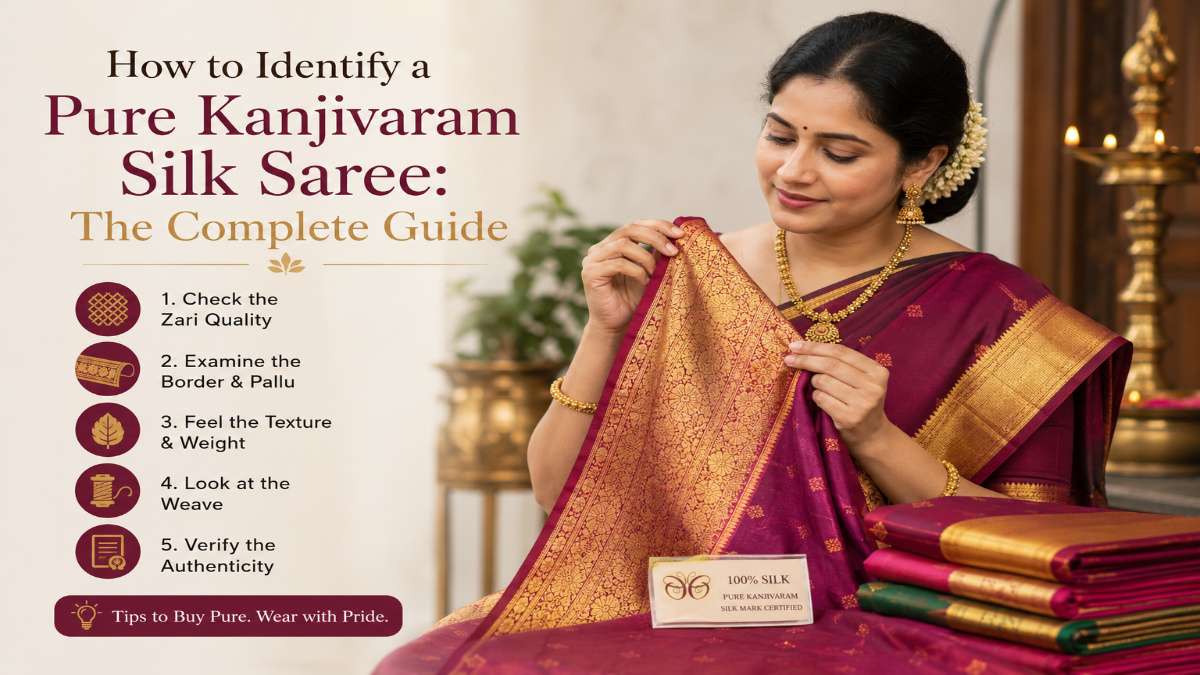
You’re standing in a silk store. The salesperson is enthusiastic. The saree looks stunning. And the price tag has enough zeros to make you blink twice. But is it real?
Knowing how to identify a pure Kanjivaram silk saree is not just smart shopping — it’s self-defence. The market is full of clever imitations, and without the right knowledge, you could end up paying bridal prices for something that’s basically fancy polyester.
This guide gives you everything you need. No jargon. No guesswork. Just clear, reliable tests backed by trusted sources.
What Makes a Kanjivaram Saree Special?
Before we get into the tests, let’s quickly understand what you’re actually buying.
Kanjivaram sarees — also called Kanchipuram silk sarees — come from Kanchipuram, a town in Tamil Nadu, India. This region has been a weaving hub for centuries. Authentic Kanjivaram sarees are woven from pure mulberry silk and interlaced with real silver and gold zari threads.
A single high-quality saree can take a skilled weaver 15 to 20 days to complete. That’s the reason genuine pieces start at around ₹15,000 and go well above ₹1,00,000 for heavily zari-worked bridal sarees. So if someone offers you a “pure Kanjivaram” at ₹2,000, run — or at least ask some very pointed questions.
1. The Touch Test: Feel Tells a Lot
Start simple. Just hold the saree.
Pure Kanjivaram silk feels smooth, firm, and slightly cool against your skin. It has a natural weight and richness to it. Synthetic fabric, on the other hand, feels either too slippery or slightly plastic-y — and it stays neutral or warm to the touch instead of cool.
Run your fingers over the surface slowly. You should feel a subtle texture from the weave, not a uniform, machine-perfect finish. Handloom work always has tiny natural irregularities. That’s not a flaw — that’s authenticity.
2. The Weight Test: Real Silk Has Substance
Pick up the saree and feel its heft.
A genuine six-metre Kanjivaram saree in pure mulberry silk typically weighs between 700 to 950 grams. The border and pallu are noticeably heavier than the body because of the dense zari work concentrated there.
If the saree feels surprisingly light — almost like chiffon or georgette — something is off. Lightweight fabric means less silk content, which usually means a blend or a synthetic substitute.
If you’re buying online, you can use a kitchen scale to verify the weight once the saree arrives. An underweight piece at, say, 400 grams, is almost certainly not pure silk.
3. The Burn Test: The Most Definitive Check
This test is a classic — and it works.
Take a small, loose thread from an inconspicuous area of the saree (ask the seller’s permission first, or save any threads that naturally fall during handling). Burn it with a lighter.
- Pure silk burns slowly, smells like burnt hair, and leaves behind a soft, crumbly ash.
- Synthetic fabric melts, produces a chemical or plastic odour, and leaves a hard bead-like residue that doesn’t crumble.
The burnt hair smell might be unpleasant, but it’s the smell of money well spent. The burnt plastic smell? That’s your wallet crying.
4. The Zari Test: Where Most Fakes Get Caught
The zari — those beautiful gold and silver threads in the border and pallu — is where a lot of imitations fall apart.
Authentic Kanjivaram sarees use real zari made by wrapping silver threads with silk and then electroplating them with 22-karat gold. This gives the zari a rich, slightly muted shine that looks elegant, not garish.
Fake zari uses plastic or copper wire. It looks overly shiny, feels lightweight, and may lose colour over time.
Here’s how to test it:
The Scratch Test: Gently scratch a small section of the zari with your fingernail or a pin. If you see a reddish thread underneath, the zari is pure (the red silk core is the mark of genuine real zari). If you see a white or plastic-looking thread underneath, it’s likely fake.
The Rub Test: Rub a section of the zari gently against a white cloth. If you see black residue, the zari likely contains artificial materials like copper or plastic. Real zari won’t leave marks.
Check Both Sides: In a genuine Kanjivaram, the zari work appears equally detailed and well-defined on both sides of the fabric. If the back looks messy or unfinished, the saree’s authenticity is questionable.
5. The Ring Test: Old School, Still Reliable
This is a traditional test that weavers and connoisseurs have used for generations.
Take a regular-sized ring and try to pass the saree through it. Pure Kanjivaram silk, made from fine mulberry silk threads, is soft and smooth enough to slide through with ease. If it gets stuck or bunches up awkwardly, the fabric is likely a stiffer synthetic blend.
This test works best on the body of the saree, not the heavily woven border area.
6. The Korvai Weave: The Signature of Authenticity
One feature separates a genuine Kanjivaram from almost every imitation — the Korvai technique.
In an authentic Kanjivaram saree, the body, borders, and pallu are woven separately and then interlocked together. This creates a zig-zag joint where the border meets the body. Look closely at the edge where the border connects to the main fabric — you should see this distinctive interlocked join on the reverse side.
In fake sarees, the border is often just printed on or stitched in a way that doesn’t have this unique interlocked structure.
The Korvai technique is reportedly over 2,000 years old. It is one of the most defining characteristics of the craft and nearly impossible to convincingly replicate cheaply.
Banarasi Saree: India’s Most Iconic Weave
7. The Silk Mark Label: Your Official Government Guarantee
This is perhaps the easiest and most trustworthy verification method.
The Silk Mark Organisation of India (SMOI) was launched on 17th June 2004 under India’s Central Silk Board, Ministry of Textiles. It introduced an official label — the Silk Mark — to certify that a product is made from 100% genuine natural silk.
A saree with the Silk Mark label carries a holographic tag with a unique serial number. Modern labels also include a QR code that you can scan to verify the seller’s details and authenticity instantly.
One important note: Silk Mark certifies the silk fibre, not the zari. So always combine the Silk Mark check with the zari tests mentioned above for complete assurance.
You can verify any Silk Mark tag’s serial number on the official SMOI website: silkmarkindia.com
If the seller cannot produce this label, ask why. A legitimate seller of pure Kanjivaram silk will not hesitate.
8. Motifs and Craftsmanship: Trained Eyes Win
Genuine Kanjivaram sarees feature intricate traditional motifs — temple borders, peacocks, paisleys, checks, elephants, and mythological scenes. These designs are woven into the fabric, not printed on top.
Look closely at the motifs. In a real saree:
- Designs are symmetrical and precise.
- There are no loose or dangling threads.
- The pattern continues seamlessly from the body into the pallu.
Mass-produced imitations often have motifs that look slightly blurry or uneven up close, because they use printing techniques rather than weaving.
9. The Sound Test: Silk Has a Voice
Gently rub the fabric between your fingers or let the saree drape freely and rustle. Pure silk produces a soft, crisp sound — sometimes described as a “singing” or “whispering” rustle. Weavers and longtime buyers often call it the “voice” of silk.
Synthetic fabrics either produce a harsher, plastic-like rustling sound or no distinctive sound at all.
10. Price Reality Check: If It Sounds Too Good, It Is
This isn’t a test you perform on the saree — it’s one you perform on the offer.
Genuine Kanjivaram sarees cannot be made below a certain cost. The price reflects the quality of the mulberry silk, the real zari, the handwork, and the 15–20 days of weaving by skilled artisans. Entry-level authentic pieces start at around ₹6,000 to ₹8,000 for simpler designs. Traditional sarees with good zari borders typically range from ₹12,000 to ₹35,000. Heavily zari-worked bridal pieces can go from ₹40,000 to ₹2,00,000 and beyond.
If someone is selling you a “pure Kanjivaram” for ₹1,500 to ₹3,000, it is not genuine — the raw silk alone costs more at wholesale.
Where to Buy a Genuine Kanjivaram Saree
Even the best tests won’t help you if the seller is unwilling to let you examine the saree properly. Always buy from:
- Reputed handloom brands with transparent sourcing information
- Government silk emporiums (they stock verified silk products)
- Artisan cooperatives or direct weaver outlets in Kanchipuram
- Certified online retailers who clearly display the Silk Mark certification and provide detailed product documentation, including reverse-side photos
Be cautious with roadside stalls, pop-up exhibitions, and unverified online sellers offering heavy discounts with no certification to back it up.
Quick Reference: Real vs Fake at a Glance
| Feature | Pure Kanjivaram | Imitation |
|---|---|---|
| Weight | 700–950 grams | Under 500 grams |
| Touch | Smooth, cool, firm | Slippery or plastic-y |
| Burn test | Burnt hair smell, crumbly ash | Plastic smell, hard bead |
| Zari scratch | Reddish thread underneath | White or plastic thread |
| Korvai join | Clear zig-zag interlock | Stitched or printed edge |
| Silk Mark | Present with QR code | Absent or unverifiable |
| Price | ₹6,000 and above | Suspiciously cheap |
Final Word
A pure Kanjivaram silk saree is not just clothing. It is a piece of living history — woven over weeks by artisans whose families have kept this craft alive for generations. Every thread carries that legacy.
GI TAG PRODUCT – KANCHEEVARAM SILKS AND SAREES
Knowing how to identify a pure Kanjivaram silk saree means you protect yourself from fakes, and you protect the weavers whose honest work deserves honest returns.
Use the tests in this guide. Trust your instincts. Ask questions. And when you finally find the real thing, you’ll know — because nothing feels quite like it.