A suzani is not just pretty cloth. Every stitched flower on one carries a small message. Central Asian brides once embroidered these hangings for their weddings, and they packed them with symbols of luck, health, and family.
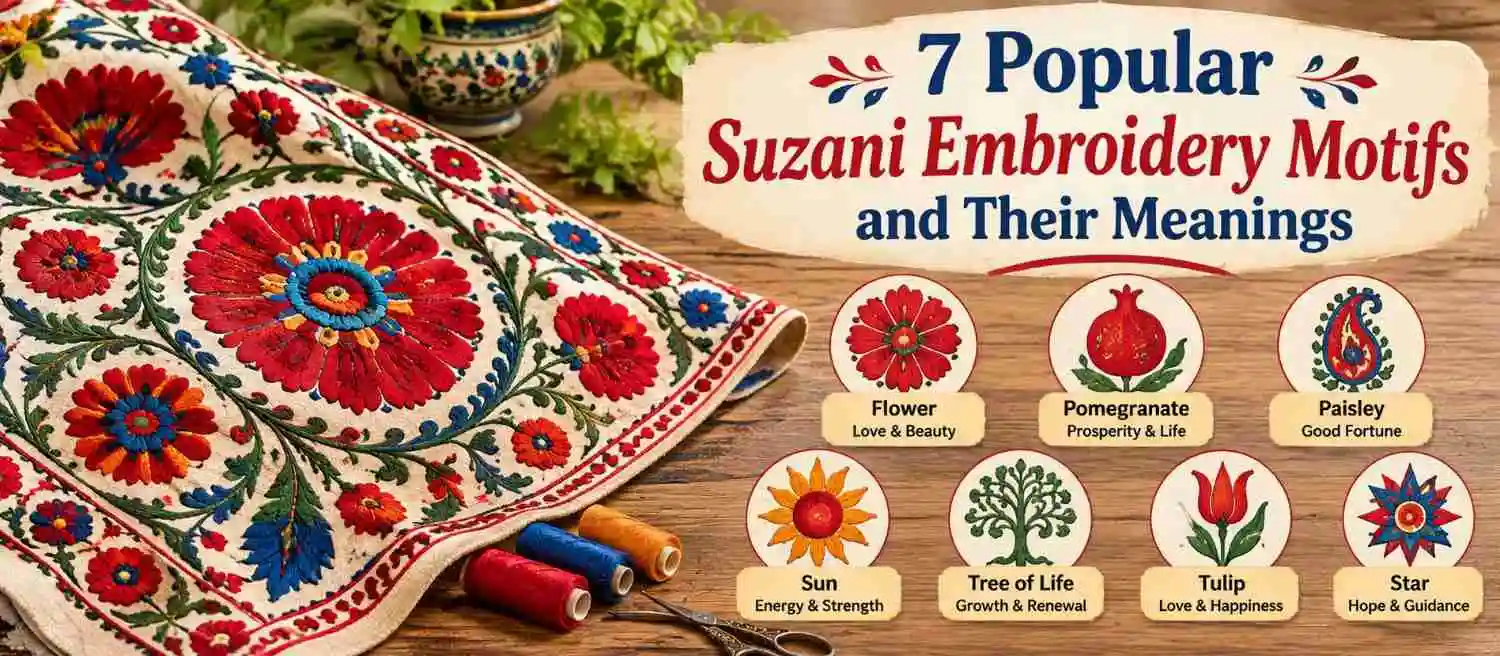
This guide covers seven popular suzani embroidery motifs and their meanings. You will also learn where suzanis come from, how makers stitch them, and why one motif can mean different things in different towns.
What Is a Suzani?
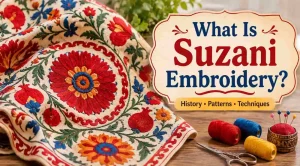
The name comes from suzan, the Persian and Tajik word for needle, according to Google Arts & Culture. So a suzani is, quite literally, a “needle thing.” Not the most poetic name for a textile that can take years to finish.
Suzanis come from the region that now covers Uzbekistan, Tajikistan, and Kyrgyzstan. The Textile Museum at George Washington University notes that both nomadic and settled women made them by hand at home for everyday uses, from bedding to protective wrappings.
By the 19th century, large embroidered panels for the bride’s dowry had become popular with Tajik farmers and settled Uzbeks, as Voices on Central Asia reports. Brides then presented the finished cloth to the groom on the wedding day.
Making one took serious effort. Central-asia.guide says a suzani usually took one or two years of skilled work. The Tsaritsyno Museum adds that some families started a girl’s dowry embroidery soon after her birth.
Makers use several stitches, including chain, satin, buttonhole, and couching. They often embroider the cloth in separate strips and join them afterward. That is why motifs sometimes sit a little out of line at the seams, as Google Arts & Culture points out.
How to Read Suzani Motifs
Think of a suzani as a stitched alphabet. Each region built its own set of designs. The Steptoe & Johnson Collection explains that experts can often identify where a suzani comes from by its design. It also says most motifs stand for health, power, happiness, good fortune, or fertility.
One honest warning before we start: meanings vary by region and by source. Even specialists disagree about some symbols. Treat the list below as a well-sourced guide, not a secret code.
1. Sun and Moon Discs
Big circles dominate many suzanis. Saudi Aramco World explains that eastern suzanis sit close to the nomad designs of the Kyrgyz and Uzbeks, who worshipped the sun, moon, and stars before Islam arrived.
Here is the fun part. Specialists still debate what the central circle means. It might be the sun, the moon, the heavens, a flower, or an open pomegranate.
Some designs name the idea outright. The Homo Faber guide says oy-palak embroidery shows a stylised picture of the universe, with sun and moon symbols. Tashkent makers also produce a “paliak” suzani with a moon design, per the Steptoe & Johnson Collection.
So when you see a giant disc, you are looking at the cosmos. Not bad for a bedspread.
2. The Pomegranate
If suzanis had a mascot, the pomegranate would apply. Homo Faber calls it a favourite among Uzbek embroiderers and says people long read it as a symbol of life, abundance, fertility, and love.
Another source adds a money angle. A cultural overview of Uzbek patterns says the pomegranate stands for wealth. It also says embroiderers in Nurata use the pomegranate ornament often.
Saudi Aramco World places the open pomegranate in a much bigger story. It calls the fruit a symbol of fertility from the Mediterranean to China.
That makes sense on a wedding textile. Few fruits wish a young couple more good things at once.
3. The Tulip
Flowers fill suzanis, and the tulip appears again and again. Craft Atlas lists tulips, carnations, and irises as typical suzani flowers, alongside leaves, vines, and fruit.
The tulip also carries a meaning. The Uzbek patterns overview says a tulip means innocence. A tulip on a bridal cloth therefore reads as a tender message, not just decoration.
Makers often call generic flowers gul, which simply means flower. Society.uz notes that embroiderers sometimes used that word for plant motifs without naming the exact bloom. So not every petal has a secret meaning.
4. The Almond
The almond looks humble, yet embroiderers loved it. The Uzbek patterns overview says almonds symbolise longevity.
Society.uz adds a protective layer. It reports a belief that the almond, a frequent embroidery motif, could shield children from evil spirits.
Long life plus a guard for the kids. If you are designing a family heirloom, that is a strong pair.
5. The Pepper
Peppers rarely win beauty contests, yet they earned a place on suzanis. Society.uz says people believed pepper drove away evil forces.
Think of the pepper as a bodyguard in red. It does not need to look elegant. It just needs to do its job.
This motif shows something important about suzanis. They served as decoration and as protection. Central-asia.guide says suzanis hung in homes since ancient times and worked like amulets.
6. The Oil Lamp
This motif surprises many newcomers. The Advantour guide to Uzbek embroidery says some suzanis include Zoroastrian symbols, such as oil lamps framed by floral motifs.
Zoroastrianism predates Islam in the region. So the lamp hints at older beliefs that survived inside later folk art. Pair it with the sun and moon discs, and you can see how many layers of history one cloth can hold.
7. The Poppy and the Cornflower
Some motifs carry characters, not concepts. The Uzbek patterns overview says a cornflower denotes a young man and a red poppy suggests a girl.
Now picture both flowers on a wedding cloth. The pair tells a small love story in thread.
The same overview lists a few more meanings worth knowing. A rose conjures beauty, a ram suggests courage, and a nightingale suggests wisdom. Use them as bonus motifs if you want to read a suzani like a pro.
Also Read:
Why Regions Change the Meaning
Not all suzanis look alike. Advantour groups Uzbek embroidery into three main styles: Bukhara, Samarkand, and Fergana. Each region differs in motif, layout, pattern density, and colour palette.
Bukhara shows a regal side. Voices on Central Asia notes that Bukhara embroidery stood out for its rich decoration, as Bukhara was a wealthy city. The same source says Samarkand embroidery leaned toward folk traditions.
Nurata work shares Bukhara’s look. Advantour describes it as many floral patterns on a light background. Shakhrisabz suzanis feature big rosettes and leafy rings, as Khinkhwab explains.
Tashkent adds its own twist. The Steptoe & Johnson Collection names two kinds from there: the “paliak” with a moon design, and the “gulkurpa,” a flower cloth.
This variety explains why two suzanis can use the same motif and still feel different. Place, wealth, and family taste all shape the stitching.
Suzani Today
The craft is getting fresh attention. Middle East Eye reports that Bukhara joined the UNESCO Creative Cities Network in October 2023. The same outlet says Uzbekistan’s border opening in 2017 sparked new interest in its needlecraft.
Advantour also notes that Samarkand hosted an exhibition on Uzbek embroidery traditions in 2025, during the 43rd session of the UNESCO General Conference.
If you shop for a suzani, remember what you are buying. You are not just buying a wall hanging. You are buying months or years of handwork, plus a set of symbols that families once chose with care.
Quick Recap: 7 Suzani Motifs at a Glance
- Sun and moon discs: the cosmos, rooted in pre-Islamic nomad beliefs
- Pomegranate: life, abundance, fertility, love, and wealth
- Tulip: innocence
- Almond: longevity and protection for children
- Pepper: protection against evil forces
- Oil lamp: Zoroastrian symbolism
- Poppy and cornflower: a girl and a young man
Final Thoughts
Suzani embroidery motifs work like a family’s wish list in thread. Each flower, fruit, and disc says something about luck, love, or protection. Meanings shift by region, and experts still debate a few. That mystery adds to the charm.
Next time you spot a suzani, look closely. Count the discs. Find the pomegranate. Spot the tiny pepper guarding the corner. The cloth has a lot to say, and now you can follow along.
Sources
- Google Arts & Culture, suzani collection entries: https://artsandculture.google.com/asset/cAEwKX3q1XAxEg
- Google Arts & Culture, suzani with floral motifs: https://artsandculture.google.com/asset/polychrome-embroidered-suzani-with-floral-motifs/iAGMuUnZFx4pxg